
Table of Contents
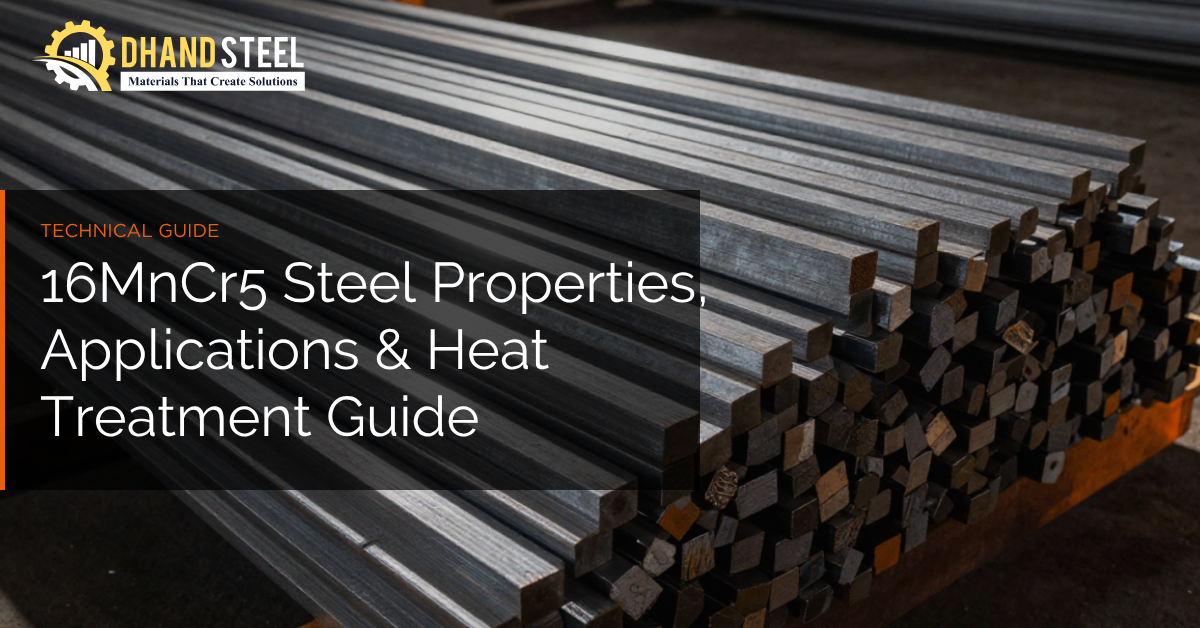
16MnCr5 Steel Properties make this grade one of the most preferred case-hardening alloy steels in the automotive, engineering, and manufacturing industries. Known for its excellent wear resistance, high surface hardness, and strong core toughness, 16MnCr5 steel is widely used for gears, shafts, pinions, transmission components, and other critical engineering applications.
Manufacturers, OEMs, and procurement professionals often evaluate 16MnCr5 steel properties before selecting materials for demanding applications that require durability, fatigue resistance, and reliable performance. Its excellent response to carburizing and heat treatment further makes it a popular choice for automotive and industrial components.
In this guide, we explore 16MnCr5 steel properties, chemical composition, mechanical characteristics, heat treatment processes, equivalent grades, and industrial applications.
For manufacturers, OEMs, and procurement professionals, understanding 16MnCr5 steel properties is essential when selecting materials for high-performance mechanical applications.
In this guide, we explain the chemical composition, mechanical properties, heat treatment process, equivalent grades, and industrial applications of 16MnCr5 steel.
What is 16MnCr5 Steel?
16MnCr5 is a low-carbon chromium-manganese alloy steel designed primarily for case hardening applications. It offers a unique combination of:
- Hard wear-resistant surface
- Tough and ductile core
- Excellent machinability before heat treatment
- Good fatigue resistance
- Superior performance under dynamic loading conditions
The steel is extensively used in applications where components are subjected to friction, impact loads, and repeated stress cycles.
16MnCr5 Chemical Composition
The typical chemical composition of 16MnCr5 steel is:
| Element | Percentage (%) |
|---|---|
| Carbon (C) | 0.14 – 0.19 |
| Silicon (Si) | 0.15 – 0.40 |
| Manganese (Mn) | 1.00 – 1.30 |
| Chromium (Cr) | 0.80 – 1.10 |
| Phosphorus (P) | ≤ 0.025 |
| Sulfur (S) | ≤ 0.035 |
Role of Alloying Elements
Carbon
- Improves hardness after carburizing.
- Enhances wear resistance.
Manganese
- Increases hardenability.
- Improves strength and toughness.
Chromium
- Enhances wear resistance.
- Improves fatigue strength and corrosion resistance.
Silicon
- Supports strength and deoxidation during steelmaking.
16MnCr5 Mechanical Properties
Mechanical properties vary depending on heat treatment condition and section size.
| Property | Typical Value |
|---|---|
| Tensile Strength | 800 – 1100 MPa |
| Yield Strength | 500 – 800 MPa |
| Elongation | 10 – 14% |
| Hardness (Core) | 180 – 250 HB |
| Surface Hardness After Carburizing | 58 – 62 HRC |
Key Advantages
- High surface hardness
- Excellent wear resistance
- Strong fatigue performance
- Good shock resistance
- Reliable dimensional stability after treatment
16MnCr5 Physical Properties
| Property | Value |
|---|---|
| Density | 7.85 g/cm³ |
| Modulus of Elasticity | 210 GPa |
| Thermal Conductivity | 46 W/mK |
| Melting Range | 1420–1460°C |
These properties make 16MnCr5 suitable for precision engineering applications where dimensional accuracy and mechanical performance are critical.
16MnCr5 Heat Treatment Process
One of the most important characteristics of 16MnCr5 steel is its excellent response to heat treatment.
1. Carburizing
Carburizing enriches the surface with carbon.
Typical carburizing temperature:
- 880°C – 950°C
Benefits:
- Hard outer surface
- Improved wear resistance
- Better fatigue life
2. Hardening
After carburizing, the material is quenched.
Typical hardening temperature:
- 820°C – 860°C
Common quenching mediums:
- Oil
- Polymer solutions
3. Tempering
Tempering reduces internal stresses and improves toughness.
Typical tempering temperature:
- 150°C – 200°C
Benefits:
- Reduced brittleness
- Improved dimensional stability
- Enhanced service life
16MnCr5 Equivalent Grade
Different standards use alternative designations for similar grades.
| Standard | Equivalent Grade |
|---|---|
| DIN / EN | 16MnCr5 |
| W.Nr. | 1.7131 |
| AFNOR | 16MC5 |
| UNI | 16MC5 |
| JIS | Similar Case Hardening Grades |
| SAE/AISI | Comparable to SAE 5115 (approximate) |
Always verify specifications before substitution because exact chemistry and performance requirements may differ.
Advantages of 16MnCr5 Steel
Manufacturers prefer 16MnCr5 due to several performance advantages.
Excellent Case Hardening Ability
Produces a hard wear-resistant surface while maintaining a tough core.
High Fatigue Strength
Performs well under repeated loading and rotational stress.
Good Machinability
Easy to machine in the annealed condition before heat treatment.
Cost-Effective Performance
Provides a balance of durability, strength, and affordability.
Consistent Quality
Suitable for mass production and precision engineering applications.
Common Applications of 16MnCr5 Steel
Because of its mechanical performance and wear resistance, 16MnCr5 is widely used in industrial sectors.
Automotive Industry
- Transmission gears
- Differential gears
- Pinions
- Camshafts
- Clutch components
- Drive shafts
Engineering Industry
- Machine components
- Couplings
- Bushes
- Splined shafts
Agricultural Equipment
- Tractor transmission parts
- Gear assemblies
- Rotating components
Heavy Machinery
- Industrial gearboxes
- Power transmission systems
- Mining equipment components
Manufacturing Sector
- Precision-machined parts
- Motion-control components
- Mechanical drive systems
Why 16MnCr5 is Ideal for Gear Manufacturing
16MnCr5 is often called a gear steel because it provides:
- High tooth surface hardness
- Excellent wear resistance
- Strong core toughness
- Long operational life
- Reduced maintenance requirements
The carburized case protects gear teeth from wear while the core absorbs shock loads during operation.
This combination is difficult to achieve using standard carbon steels.
16MnCr5 vs C20 Steel
| Property | 16MnCr5 | C20 Steel |
|---|---|---|
| Alloy Content | Chromium & Manganese | Low Carbon |
| Hardenability | Excellent | Moderate |
| Wear Resistance | High | Medium |
| Gear Applications | Ideal | Limited |
| Fatigue Strength | High | Moderate |
| Case Hardening Response | Excellent | Good |
For demanding power transmission applications, 16MnCr5 generally offers superior performance.
How to Select the Right 16MnCr5 Steel Supplier
Industrial buyers should evaluate suppliers based on:
Material Traceability
Ensure proper documentation and test certificates.
Manufacturing Quality
Look for consistent dimensional accuracy and surface finish.
Grade Availability
Verify availability in required sizes and specifications.
Technical Support
Choose suppliers capable of assisting with material selection.
Industry Experience
Experienced manufacturers can better understand engineering requirements.
Frequently Asked Questions
Is 16MnCr5 a case-hardening steel?
Yes. 16MnCr5 is specifically designed for carburizing and case-hardening applications where a hard surface and tough core are required.
What is the hardness of 16MnCr5 after carburizing?
After proper carburizing and hardening, surface hardness typically reaches 58–62 HRC.
What are the main applications of 16MnCr5 steel?
The grade is commonly used for gears, shafts, pinions, camshafts, transmission parts, and engineering components.
What is the equivalent grade of 16MnCr5?
Common equivalents include W.Nr. 1.7131 and similar case-hardening grades used under various international standards.
Why is 16MnCr5 used for gears?
Its ability to develop a hard wear-resistant surface while maintaining a tough core makes it ideal for gear manufacturing.
Conclusion
16MnCr5 is a high-performance case-hardening steel widely used across automotive, engineering, manufacturing, and heavy machinery industries. Its excellent combination of wear resistance, toughness, fatigue strength, and heat-treatment response makes it one of the most reliable choices for gears, shafts, and critical power transmission components.
For businesses seeking durable engineering steel solutions, understanding 16MnCr5 steel properties, heat treatment methods, and application suitability is essential for selecting the right material for long-term performance.
Request Technical Datasheet
Looking for high-quality 16MnCr5 steel bars for your manufacturing or engineering applications?
Dhand Steels manufactures and supplies premium engineering steel grades including 16MnCr5, 20MnCr5, SAE 1018, EN19, EN24, C20, C45, and other alloy steel bars for industrial applications.
📧 Email: solutions@dhandsteels.com
📞 Phone: +91 78147 05181
📞 Phone: +91 62838 38475
Request a technical datasheet or discuss your project requirements with our team.
Chat With Us on WhatsApp

Comments
0 Comment On Post