
EN24 Steel — High‑Strength Alloy for Heavy Engineering: Properties, Applications and Supply
EN24 is a medium‑carbon Ni‑Cr‑Mo alloy engineered to deliver high tensile strength and dependable toughness in demanding components. As a high‑strength engineering steel, EN24’s alloying—nickel, chromium and molybdenum—improves hardenability, fatigue resistance and impact performance, making it a go‑to for heavily loaded shafts, gears and connecting rods. This article lays out what EN24 is, how its chemistry and metallurgy produce those properties, and why designers and procurement teams specify it for high‑duty parts. You’ll find clear chemical and mechanical EAV tables, practical heat‑treatment guidance, machining and forging notes, plus a summary of common bright‑bar forms and dimensions. We also compare EN24 with equivalents such as AISI 4340 and BS 817M40 to help with substitution decisions. Finally, there’s a concise supplier note for teams sourcing EN24 bright bars for production or prototyping.
Dhand Steels manufactures, supplies and exports EN24 alloy bright bars and serves customers in heavy engineering. We position ourselves around precision, consistent quality, practical cost solutions and a sustainability promise we call “smarter steels” — aiming to reduce carbon and energy use across the supply chain. If you need EN24 bright bars in standard stock sizes or custom lengths, Dhand Steels can provide product details and quotations through our procurement channels. Below we define EN24 in detail and compare it with equivalent grades so you can set clear expectations for performance and selection.
What is EN24 Steel? Comprehensive Overview and Key Characteristics
EN24 is a medium‑carbon, high‑strength alloy steel whose performance comes from deliberate additions of nickel, chromium and molybdenum. These elements increase hardenability and help retain toughness so that, after the correct heat treatment, EN24 achieves high tensile strength while still resisting impacts under cyclic loading. The grade is commonly supplied as bright bars in either machined‑ready or forge‑ready condition and maps to similar alloy philosophies in grades like AISI 4340 and BS 817M40. Engineers specify EN24 when components face alternating bending, torsion and shock because its chemistry supports deep hardening and a strong strength‑to‑toughness balance. Knowing which elements drive those properties also makes it clear why processing — heat treatment and finish — determines the final in‑service behavior.
What defines EN24 steel and its alloy composition?
EN24’s performance is set by a core mix of carbon, nickel, chromium and molybdenum, each with a defined metallurgical role. Carbon provides baseline strength and hardenability, held at a level that preserves toughness after tempering; nickel boosts impact toughness and ductility; chromium improves hardenability and wear resistance; and molybdenum increases temper resistance and hardenability in thicker sections. Controlled additions of manganese and silicon support deoxidation and processing without compromising fatigue life. Typical composition bands vary by standard and supplier, but they’re selected so heat treatment produces a tempered‑martensitic microstructure that delivers EN24’s characteristic strength and toughness combination.
How does EN24 steel compare to equivalent grades like 4340 and 817M40?
EN24, AISI 4340 and BS 817M40 sit in the same Ni‑Cr‑Mo alloy family and are often interchangeable when mechanical targets and certification needs align. After equivalent heat treatment, all three provide comparable hardenability and tensile capability, with small compositional differences affecting temper response and fatigue behavior. Substitution is common where mechanical ranges meet design limits and traceability is acceptable. When choosing among them, pay attention to supplier chemistry control, documented heat‑treatment history and part geometry — thicker or complex sections often demand higher nickel and molybdenum for deeper hardenability.
What are the Essential Properties of EN24 Steel for Heavy Engineering?

EN24’s suitability for heavy engineering comes from its alloy balance, mechanical strength, hardenability and retained toughness after heat treatment. The chemistry controls how sections respond to quench‑and‑temper cycles; mechanical properties — tensile strength, yield, hardness and impact energy — set allowable loads and expected life; and physical traits such as density and thermal conductivity affect fatigue and heat‑affected performance. The tables below list the common chemical ranges and mechanical bands associated with EN24, followed by notes that relate those numbers directly to component behavior in service.
The tables map alloy elements and mechanical attributes to their practical roles for designers and procurement teams. Treat the ranges as typical targets rather than guaranteed values — final numbers depend on supply condition and heat treatment.
Intro to chemical composition table: The table lists the principal alloying elements, their usual percentage ranges and the metallurgical role each plays in EN24’s performance.
| Element | Typical % Range | Role / Functional Effect |
|---|---|---|
| Carbon (C) | ~0.36–0.44% | Provides base hardenability and strength while remaining balanced for toughness after tempering |
| Nickel (Ni) | ~1.4–2.0% | Improves impact toughness, ductility and deep‑hardening capability |
| Chromium (Cr) | ~0.8–1.1% | Increases hardenability, wear resistance and tempering stability |
| Molybdenum (Mo) | ~0.25–0.35% | Enhances hardenability and temper resistance at elevated temperatures and in thick sections |
| Manganese (Mn) | ~0.35–0.6% | Assists strength and deoxidation; supports overall hardenability |
| Silicon (Si) | ~0.1–0.35% | Acts as a deoxidizer and contributes modestly to strength |
| Phosphorus/Sulfur (P,S) | ≤0.035% each | Kept low to minimise embrittlement and fatigue sensitivity |
This composition explains why EN24 accepts deep quench hardening and tempering while preserving impact resistance in thicker sections. The next section quantifies the mechanical outcomes designers typically expect after standard heat treatments.
What is the chemical composition of EN24 steel?
EN24’s chemistry focuses on a controlled carbon level with intentional additions of nickel, chromium and molybdenum so the steel can be hard‑quenched and tempered without becoming excessively brittle. The ranges listed above reflect a balance between strength and toughness: nickel lifts impact performance, chromium and molybdenum boost hardenability and temper stability, and manganese and silicon help processing. Suppliers may vary the exact ranges for supply conditions, but the functional roles remain the same — enabling deep hardening, predictable temper response and acceptable machinability in intermediate conditions. Knowing these roles helps when you specify pre‑ and post‑machining steps and when predicting heat‑treatment outcomes.
Intro to mechanical properties table: The table summarises typical mechanical property bands for EN24 after representative heat‑treatment cycles and explains their application implications.
| Mechanical Property | Typical Range / Units | Implication for Application |
|---|---|---|
| Tensile strength (Rm) | ~850–1100 MPa | Provides high load capacity for shafts and gears |
| Yield strength (Rp0.2) | ~650–900 MPa | Sets the elastic limit and safety margins |
| Hardness (HRC) | ~28–45 HRC (varies with temper) | Represents the trade‑off between machinability and wear resistance |
| Impact energy (Charpy) | ~20–60 J | Indicates toughness under shock loading |
| Fatigue endurance | Dependent on surface finish & heat treat | Surface condition and tempering are critical for service life |
These bands show EN24’s wide applicability to components under high static and dynamic loads. Precise properties depend on quench/temper schedules and section size, so specify target tensile, hardness and toughness values rather than relying only on the grade name.
Which mechanical properties make EN24 suitable for demanding applications?
EN24 gains its mechanical performance from quench and temper cycles that produce a tempered martensitic matrix — delivering high tensile strength with usable ductility. The tensile and yield ranges enable engineers to size parts for heavy bending, torsion or axial loads while keeping practical safety factors. The hardness range highlights the familiar compromise: higher hardness increases wear resistance and fatigue strength but lowers machinability and impact toughness. Impact energy figures show EN24 keeps meaningful toughness, essential for parts exposed to shocks or abrupt load reversals. For critical components, specify post‑treatment targets and request supplier test certificates to ensure in‑service performance.
How is EN24 Steel Used in Heavy Engineering and Related Industries?

EN24 is widely used where high tensile strength, toughness and fatigue resistance are required for parts that see repeated loading and impact. Its predictable heat‑treatment response and ability to harden deeply in larger sections make it a preferred choice for rotating machinery and structural components that must balance hardness with ductility.
Industries that commonly rely on EN24 include heavy engineering, automotive, aerospace subassemblies, agricultural machinery and tooling — anywhere strength‑to‑weight and lifecycle under cyclic stresses matter. The lists below show typical heavy engineering components and the reasons EN24 is selected.
- Shafts and axles: High tensile strength and toughness reduce the risk of fatigue fracture under bending and torsion.
- Gears and pinions: Hardenable core with a tempered surface provides wear resistance needed for transmission duty.
- Connecting rods and crank components: Combines strength and impact resistance for reciprocating loads.
These examples illustrate how EN24’s metallurgical profile translates into longer life and predictable maintenance intervals for heavy equipment. The next section drills into specific component examples and design considerations.
Which heavy engineering components commonly use EN24 steel?
Common heavy engineering components made from EN24 include machine tool spindles, industrial gearbox shafts, heavy‑duty couplings and large rotating shafts in pumps and compressors. Engineers choose EN24 because it can be through‑hardened to give a tough core and a tempered surface that resists wear without becoming brittle. Typical design items to specify are surface finish (ground or polished), final hardness bands to balance wear and machinability, and any post‑repair heat treatment to restore toughness. Service temperatures are usually ambient to moderately elevated — EN24 is not intended for continuous high‑temperature creep service.
What are EN24 steel applications in aerospace and automotive sectors?
In aerospace and high‑performance automotive work, EN24 is used for landing‑gear subcomponents, high‑stress shafts and performance crankshafts where strength‑to‑weight and fatigue resistance are critical. These sectors require traceability and documented heat‑treatment records and often call for tight mechanical bands and non‑destructive testing on critical parts. EN24’s capacity to reach high tensile strengths while retaining toughness makes it suitable for dynamic components, provided process control and inspection meet sector standards.
How is EN24 Steel Processed? Heat Treatment, Machinability, and Forging Insights
Correct processing unlocks EN24’s engineered properties — heat treatment sets final hardness, toughness and fatigue life. Standard routes are hardening (austenitizing and quenching) followed by tempering to reach the desired balance of strength and ductility. Normalizing or annealing can improve grain structure before forming or machining, and forging requires controlled deformation temperatures to preserve hardenability. Machinability depends heavily on condition: normalized or annealed EN24 machines easily, while quenched‑and‑tempered material is tougher to cut. Welding is possible but needs preheat and post‑weld tempering to avoid cracking risks.
- Austenitize (hardening): Heat to the recommended austenitizing temperature to dissolve alloy carbides and prepare for quenching.
- Quench: Rapid cool to form martensite and achieve high as‑quenched hardness.
- Temper: Reheat to the chosen tempering temperature to set hardness, increase toughness and relieve stresses.
These steps form a practical roadmap to hit specific mechanical targets; the following subsection gives temperature ranges and tempering notes to refine the sequence.
What are the recommended heat treatment processes for EN24 steel?
Typical hardening for EN24 starts with austenitizing in a controlled furnace, followed by oil or polymer quenching to form martensite; tempering then reduces brittleness and establishes the required hardness. Representative austenitizing temperatures commonly fall in the 830–860°C range, with tempering set to achieve the target HRC or strength band. Annealing and normalizing improve machinability and microstructural uniformity before heavy machining or forging. The EN24T condition denotes a tempered supply variant delivered at a specified hardness that’s ready for machining or assembly.
How do machinability and welding considerations affect EN24 steel usage?
EN24 machines well in normalized or annealed states but becomes progressively harder to machine as hardness rises after tempering — many manufacturers rough machine in a softer condition and finish after tempering. Welding EN24 requires preheating, controlled interpass temperatures and post‑weld tempering or stress relief to avoid hydrogen‑induced or HAZ cracking. For fatigue‑critical parts, forging is often preferred to welding because it preserves grain continuity and reduces stress concentrators. If welding is unavoidable, use qualified filler metals and documented procedures to restore mechanical integrity.
What Are the Available Forms and Dimensions of EN24 Bright Bars?
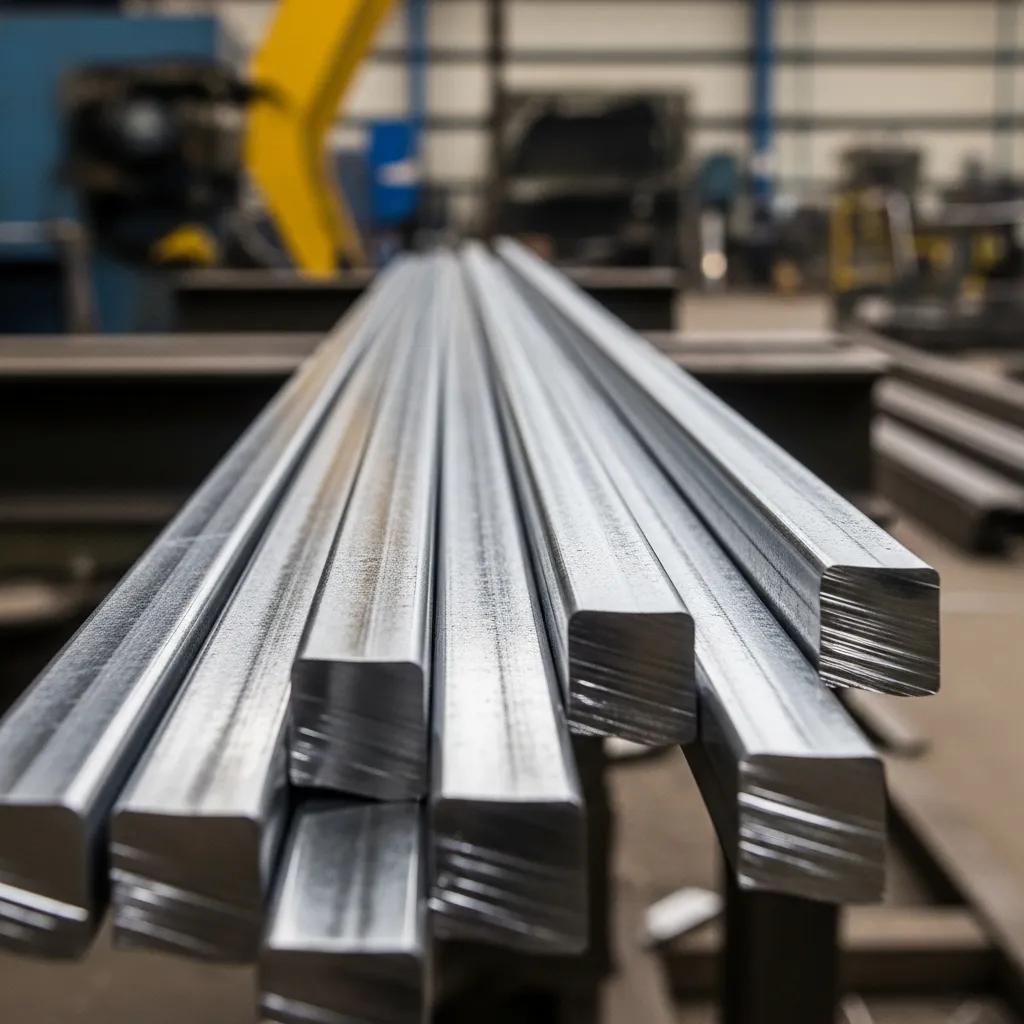
EN24 bright bars are stocked in common profiles to match machining and production workflows: round, hex, square and flat sections. Bright bars are produced to tight dimensional tolerances with a smooth finish that reduces downstream machining and improves surface fatigue performance. The EN24T condition — a tempered supply state — balances machinability with mechanical readiness and enables faster turnarounds where additional tempering isn’t required. The table below compares typical product variants, standard dimensions and recommended uses to help with purchasing decisions.
Intro to product variant table: This table maps common bright‑bar profiles to standard dimensions and suggested use cases for procurement reference.
| Product Variant | Standard Dimensions / Condition | Typical Uses / Stock Notes |
|---|---|---|
| Round bright bars | Diameters 12–200 mm; lengths to customer spec; EN24T option | Shafts, pins and turned components; widely stocked |
| Hex and square bars | Across‑flats / side sizes common to machining centres | Fasteners, forged blanks and coupling components |
| Flat bars | Thicknesses 6–100 mm; widths per order | Brackets, tooling and structural parts requiring machining |
| EN24T conditioned bars | Tempered to specified hardness; available across profiles | Ready‑to‑machine bars that balance toughness and finishability |
Use this comparison to match geometry and supply condition to your manufacturing workflow; specifying EN24T can shorten lead times when intermediate hardness and machinability are priorities.
Which types of EN24 bright bars does Dhand Steels supply?
Dhand Steels stocks bright bars and alloy bright bars and explicitly lists EN24 among the grades we supply. We commonly offer round bright bars in a range of diameters and can provide hex, square and flat sections on request to serve heavy engineering needs. Customers typically ask for stock availability, specific lengths or EN24T conditioned bars based on machining plans and delivery schedules. To get precise stock and lead‑time information, request a formal quote specifying grade, diameter, quantity and desired supply condition.
Multiple bar profiles let engineers choose shapes that minimise machining waste and speed up throughput. The list below summarises typical bar types buyers consider when sourcing EN24.
- Round bright bars: Preferred for turned shafts and precision spindles.
- Hex and square bars: Useful for fasteners and small forged components.
- Flat bars: Selected for brackets, plates and applications needing flat stock.
These product options help manufacturers streamline fabrication and reduce material‑to‑part processing time.
What are the standard dimensions and conditions like EN24T?
Standard bright bar diameters and thicknesses reflect common machining and stock practices — round bars start at small diameters for pins and shafts and extend to larger sizes for heavy shafts and forgings. EN24T denotes a tempered supply condition where bars are delivered at a specified hardness that eases machining while still offering substantial mechanical capacity. Buyers should specify both geometric dimensions and whether they want EN24 or EN24T when requesting quotes so delivered material matches downstream heat‑treatment and machining plans. If you need tight tolerances, ground finishes or certified material test reports, include those requirements in your procurement specification for accurate supplier responses.
Why Choose Dhand Steels as Your EN24 Steel Manufacturer and Supplier?
Dhand Steels is a manufacturer, supplier and exporter with capabilities aligned to heavy engineering customers looking for bright bars in alloy grades such as EN24. We emphasise dimensional control and consistent finishes suited to machined components, while delivering practical, cost‑effective production approaches. Our “smarter steels” message highlights efforts to reduce carbon and energy use in the supply chain. For procurement teams, these points signal a partner focused on tolerance control, grade availability and manufacturing efficiency.
The supplier advantages can be summarised as: alloy steel properties
- High precision and premium quality: Processes aimed at tight tolerances and reliable finishes.
- Innovative, cost‑effective solutions: Production approaches that balance performance with competitive pricing.
- Sustainability focus: “Smarter steels” commitment to lower carbon and energy intensity.
- Comprehensive grade availability: Stocking a range of alloy bright bars, including EN24, for heavy engineering needs.
We recommend weighing these value points alongside technical criteria like available stock sizes, certification capability and lead times when selecting a vendor. The next section explains what information buyers should provide when requesting quotes.
What quality and sustainability advantages does Dhand Steels offer?
Dhand Steels focuses on precision manufacturing and consistent product quality for bright bars, including grades like EN24 for heavy engineering. Our messaging includes a sustainability angle — “smarter steels” — that describes steps to reduce carbon and energy use in production. This combination of dimensional control, broad grade availability and a lower environmental footprint positions us as a supplier option for teams seeking both performance and improved supply‑chain sustainability. Buyers should request material test certificates and supply‑condition details to validate these claims for their specifications.
How can customers request EN24 steel quotes and support?
To request a quote or technical support for EN24 bright bars, prepare a short specification package listing grade (EN24 or EN24T), profile (round, hex, square, flat), diameter or dimensions, quantity, desired supply condition and any certification or testing requirements. Adding target mechanical properties, required hardness bands and finishing requests (ground, polished, toleranced) helps suppliers respond accurately and quickly. Suppliers typically return pricing, lead times and test certificates when given this information — note any urgent delivery needs or special packaging instructions. For procurement, stating machining allowances and post‑treatment plans lets the supplier recommend the most cost‑effective supply condition.
Following these steps ensures quotations are comparable and deliveries meet your manufacturing schedule. When placing an order, confirm acceptance criteria and request documentation that verifies composition, heat treatment and mechanical tests for critical parts.
Frequently Asked Questions
What industries commonly use EN24 steel?
EN24 is used across heavy engineering, automotive, aerospace subassemblies and agricultural machinery. Its combination of tensile strength and toughness makes it suitable for parts that undergo repeated loading and impact. In automotive applications you’ll find EN24 in crankshafts and connecting rods; in aerospace it appears in landing‑gear subcomponents and high‑stress shafts. Its versatility helps meet demanding reliability and performance needs in these sectors.
What are the key benefits of using EN24 steel in engineering applications?
Key benefits include a strong strength‑to‑weight ratio, high fatigue resistance and reliable toughness. These properties suit components exposed to dynamic loads and harsh conditions. EN24 is also heat‑treatable to target specific mechanical properties, allowing engineers to tailor performance to design requirements. That adaptability, together with durability, makes EN24 a preferred choice for critical engineering parts.
How does the heat treatment process affect the properties of EN24 steel?
Heat treatment has a major effect on EN24’s properties. The usual sequence — austenitise, quench and temper — alters the microstructure to raise strength and preserve toughness. Correct heat treatment can produce tensile strengths in the 850–1100 MPa range while keeping acceptable ductility. Tempering is critical: it reduces brittleness and sets hardness, balancing wear resistance against machinability. Proper processing is essential to get the performance you expect from EN24.
What machining considerations should be taken into account for EN24 steel?
Machining depends on material condition. EN24 machines well in normalized or annealed states but becomes harder to cut as hardness increases after tempering. Many manufacturers rough machine in a soft state and perform final machining after tempering. Use appropriate tooling and cutting parameters to manage tool wear and achieve required finishes and tolerances. Planning machining steps around supply condition improves efficiency and part quality.
What are the common forms and dimensions available for EN24 steel bright bars?
EN24 bright bars are available as round, hex, square and flat profiles. Typical round diameters run from 12 to 200 mm; flat bars are commonly 6–100 mm thick. The EN24T condition (tempered) is often offered to balance machinability and mechanical properties. These options help manufacturers pick the most suitable form and size for their applications and reduce material‑to‑part waste.
What factors should be considered when selecting a supplier for EN24 steel?
Consider product quality, precision manufacturing capability, grade and form availability, and the supplier’s sustainability credentials. Also check their ability to provide traceable documentation and testing, lead times, pricing and technical support. A supplier that can meet your mechanical and certification requirements will help ensure the material performs as expected in service.
Conclusion
EN24 is a proven high‑strength alloy that combines toughness and fatigue resistance for demanding engineering applications. Its heat‑treatability lets you tailor mechanical properties for critical components across multiple industries. Choosing EN24 can improve component life and reliability — and Dhand Steels can supply EN24 bright bars in common sizes or custom lengths to suit production or prototyping needs. Explore our EN24 range and request a quote to get material and delivery details tailored to your project.




Comments
0 Comment On Post