
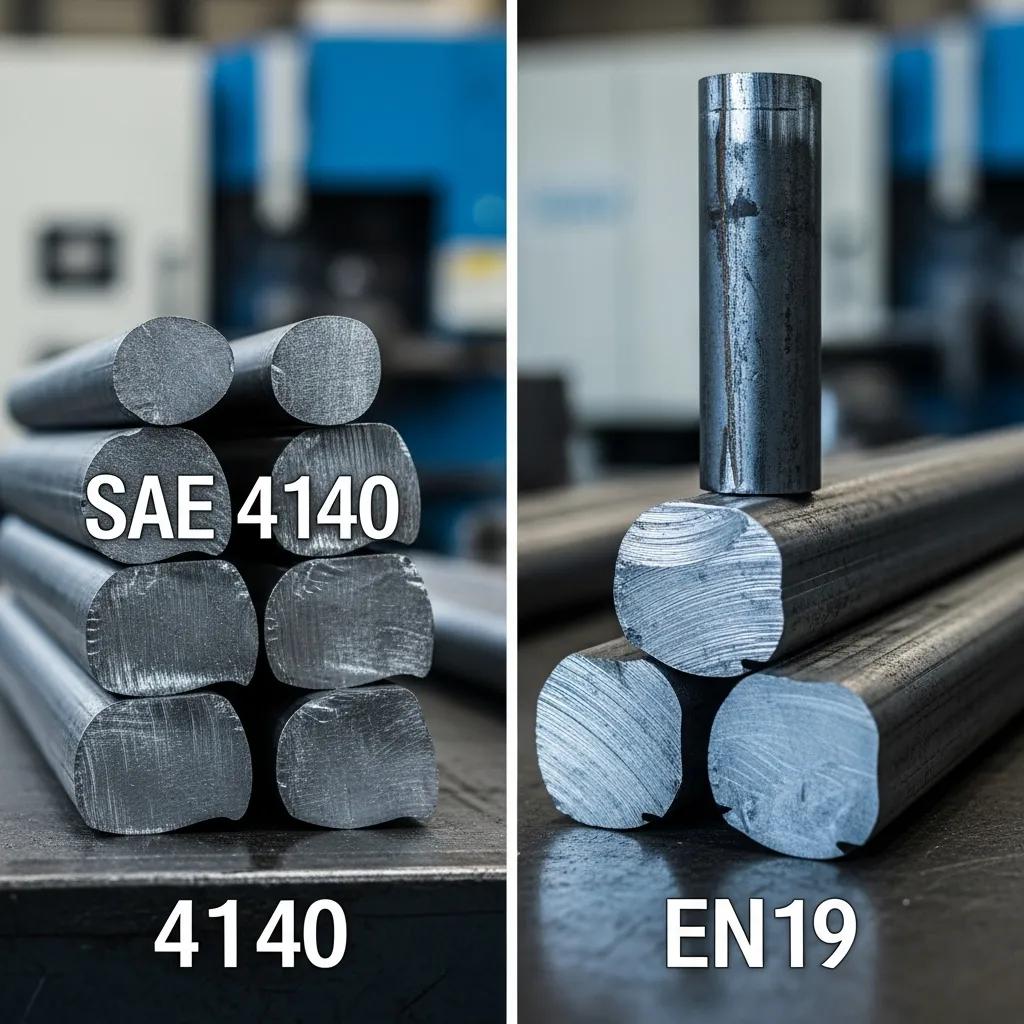
SAE 4140 vs EN19: Which Alloy Steel Best Fits Your Application?
SAE 4140 and EN19 are common chromium‑molybdenum alloy steels used across automotive, heavy engineering and oil & gas applications. SAE 4140 offers a well‑balanced mix of toughness and ductility, while EN19 can reach higher tensile strength and hardness after heat treatment. This article breaks down the chemistry, mechanical behaviour, heat‑treatment response and practical trade‑offs so design and procurement teams can pick the right grade for shafts, gears, bolts and other high‑load parts. You’ll find composition and property tables, side‑by‑side tensile and hardness ranges, guidance on machining and welding, recommended heat‑treatment windows that affect fatigue and wear performance, and a clear supplier checklist to turn a specification into a purchase. By the end you’ll have a short, practical checklist to choose between SAE 4140 and EN19 and the metrics to define performance targets.
Key properties and characteristics of SAE 4140
SAE 4140 is a Cr–Mo alloy known for a useful balance of strength, toughness and fatigue resistance — it’s a go‑to when components need load capacity without sacrificing ductility. Chromium and molybdenum raise hardenability and high‑temperature strength, while the controlled carbon level keeps the grade forgeable and machinable. The microstructure responds predictably to quench‑and‑temper cycles, letting engineers tailor hardness. Because of its resistance to shock and cyclic loading, SAE 4140 is widely specified for shafts and structural parts. The sections below list composition details and typical uses to help frame the comparison with EN19.
Chemical composition of SAE 4140
The table summarizes SAE 4140’s main alloying elements and their typical ranges. Chromium and molybdenum increase hardenability and strength; manganese and silicon aid deoxidation and toughness; carbon controls achievable hardness and must be balanced to avoid embrittlement. Designers use these ranges when writing specifications so the chosen heat‑treatment window meets target HRC and toughness.
| Grade | Element | Typical % Range |
|---|---|---|
| SAE 4140 | Carbon (C) | 0.38–0.43 |
| SAE 4140 | Chromium (Cr) | 0.80–1.10 |
| SAE 4140 | Molybdenum (Mo) | 0.15–0.25 |
| SAE 4140 | Manganese (Mn) | 0.75–1.00 |
| SAE 4140 | Silicon (Si) | 0.15–0.35 |
| SAE 4140 | Phosphorus/Sulfur (P/S) | ≤0.035 each |
These composition ranges explain why SAE 4140 is chosen for balanced performance: its carbon allows tempering to moderate HRC while Cr and Mo support deeper hardening in thicker sections. Knowing these percentages helps predict quench sensitivity and the temper temperature needed to reach target properties.
Typical applications for SAE 4140
Engineers pick SAE 4140 when a part needs strength, toughness and good machinability, and when heat treatment will be used to fine‑tune final properties. Common uses exploit the grade’s balanced profile to reduce brittle failure and deliver predictable fatigue life.
- Shafts and axles where torsional toughness is essential under cyclic loading.
- Fasteners and studs that need a balance of tensile strength and ductility.
- Gears for medium‑load applications that can be case or through‑hardened.
- Automotive parts and oil‑and‑gas tooling that require reliable fracture resistance.
These examples show SAE 4140’s suitability for parts exposed to impact and fluctuating loads. The next section contrasts this with EN19’s higher‑strength focus.
Key properties and characteristics of EN19
EN19 is a high‑tensile Cr–Mo alloy often specified where higher hardness and wear resistance matter after heat treatment. With a slightly higher carbon potential and similar Cr–Mo chemistry, EN19 reaches greater tensile strength and HRC after quench‑and‑temper cycles. That improves wear performance but reduces ductility compared with SAE 4140. Because EN19 can form more martensite, careful heat treatment is essential to avoid embrittlement. The table and notes below map EN19’s chemistry to its mechanical strengths and typical use cases.
Chemical composition of EN19
The compact table below shows typical EN19 ranges. Small increases in carbon and chromium relative to SAE 4140 raise hardness potential and wear resistance. Each element affects performance: higher carbon increases achievable HRC, chromium improves hardenability (and marginally corrosion resistance), and molybdenum helps retain strength at temperature.
| Grade | Element | Typical % Range |
|---|---|---|
| EN19 | Carbon (C) | 0.36–0.44 |
| EN19 | Chromium (Cr) | 0.90–1.20 |
| EN19 | Molybdenum (Mo) | 0.15–0.30 |
| EN19 | Manganese (Mn) | 0.60–1.00 |
| EN19 | Silicon (Si) | 0.10–0.35 |
| EN19 | Phosphorus/Sulfur (P/S) | ≤0.035 each |
These values explain EN19’s higher hardness potential compared with SAE 4140: the extra carbon and chromium allow higher martensitic hardness after quenching, while molybdenum supports toughness at elevated strengths. That chemistry determines which components suit EN19 best.
Typical applications for EN19
EN19 is chosen when wear resistance and high tensile capacity are priorities over maximum ductility. Designers specify EN19 for heavily loaded, wear‑prone parts that are routinely heat treated to higher HRC levels. Typical applications include:
- High‑load gears and pinions in heavy machinery where surface and bulk hardness reduce wear.
- Axles and shafts exposed to substantial bending and contact stress.
- High‑tensile bolts and studs that must hold clamp force under heavy loads.
- Components for agricultural and construction equipment where high hardness and retained toughness are needed.
EN19’s niche is clear: when tensile strength and wear resistance matter most, EN19 is often the preferred option — provided heat treatment and QA are controlled to avoid brittle failure.
Mechanical comparison: SAE 4140 vs EN19
A side‑by‑side mechanical comparison highlights the trade‑offs between toughness, hardness and ductility that guide material selection. SAE 4140 usually offers a balanced tensile strength and better ductility for shock‑loaded parts, while EN19 can reach higher tensile and hardness ranges after tempering, making it better for wear‑critical components. The table below lists typical numeric ranges engineers use when specifying materials.
| Grade | Property | Typical Range (Heat-treated) |
|---|---|---|
| SAE 4140 | Tensile strength (MPa) | ~655–980 |
| SAE 4140 | Hardness (HRC) | ~24–35 (depending on temper) |
| SAE 4140 | Elongation (%) | ~12–25 |
| EN19 | Tensile strength (MPa) | ~850–1,100 |
| EN19 | Hardness (HRC) | ~30–45 (depending on temper) |
| EN19 | Elongation (%) | ~8–15 |
Put simply: EN19’s higher tensile and HRC ranges give better wear resistance and load capacity, but with lower elongation and less margin against brittle fracture. SAE 4140’s broader elongation and moderate hardness make it safer for parts subject to shock or impact. These differences directly affect likely failure modes and the safety factors you’ll use in design.
Tensile strength, hardness and ductility — how they differ
Tensile strength shows the maximum load a material can carry; hardness links to wear resistance and surface life; ductility (elongation) indicates how much deformation precedes fracture. EN19 reaches higher tensile and hardness levels because of its chemistry and heat‑treatment window, letting designers target higher HRC for wear‑critical parts. SAE 4140 sacrifices some top‑end hardness to keep ductility and toughness, which makes it preferable for shafts and components that bend or see shocks. Choosing between the two comes down to whether wear resistance or ductile fracture resilience is the primary design requirement. The next section covers manufacturability factors that often decide which grade is practical for production.
Machinability and weldability: practical differences
Higher carbon and harder microstructures increase tool wear and raise the risk of cracking in the heat‑affected zone. SAE 4140, with slightly lower carbon, generally machines easier and accepts welding with standard preheat/postheat procedures. EN19 needs stricter preheat, controlled interpass temperatures and post‑weld tempering to avoid hard, brittle zones. Practical processing recommendations:
- Preheat and control interpass temperature to reduce cold‑cracking risk during welding.
- Temper after welding to restore ductility in the HAZ and relieve residual stress.
- Machine in annealed or normalized condition, then perform final hardening after heavy cutting.
- Match tool geometry and cutting speeds to expected hardness to limit tool wear.
Following these steps lowers manufacturing risk and keeps performance predictable. Also specify supplier finish (bright bars) and tolerances during procurement to avoid surprises.
Heat‑treatment processes for SAE 4140 and EN19
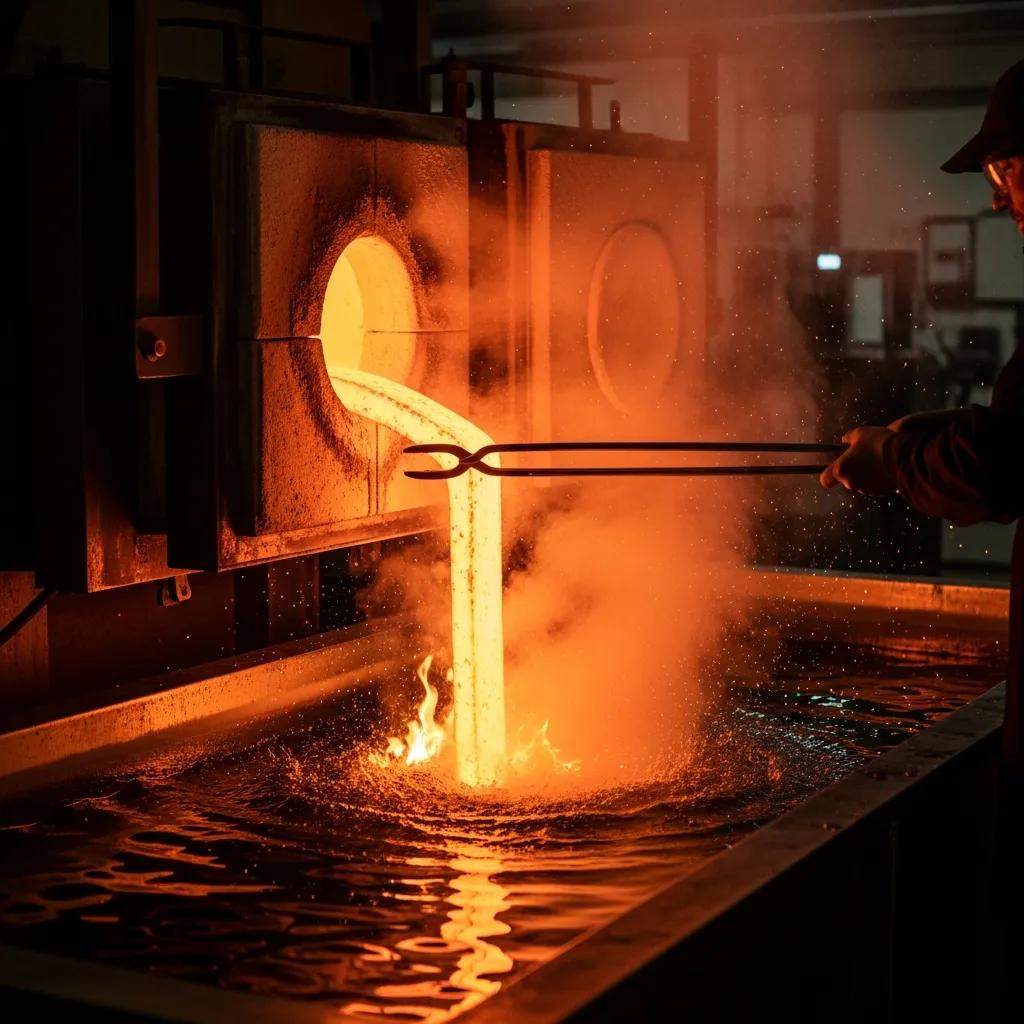
Heat treatment tailors microstructure to service needs: annealing and normalizing refine grains and dissolve carbides for better machining; quenching and tempering create martensite to raise hardness and strength. For both SAE 4140 and EN19 the typical sequence—normalize/anneal → harden (quench) → temper—controls the hardness/toughness balance. EN19 often requires more aggressive quench/temper cycles to reach higher HRC, which raises embrittlement risk without correct tempering. The table below lists typical parameter windows and the expected effects engineers reference when specifying heat treatment.
| Grade | Heat Treatment Step | Typical Parameters & Effect |
|---|---|---|
| SAE 4140 | Normalizing | 815–870°C; refines grain, improves toughness |
| SAE 4140 | Quench (hardening) | 815–860°C; oil or polymer quench; produces martensite |
| SAE 4140 | Tempering | 400–650°C; lowers hardness to target HRC while restoring toughness |
| EN19 | Normalizing | 830–880°C; grain refinement before hardening |
| EN19 | Quench (hardening) | 830–880°C; oil/polymer cooling; higher martensite fraction |
| EN19 | Tempering | 350–600°C; careful selection avoids embrittlement while hitting high HRC |
This mapping shows how process choices change microstructure and properties. Staying inside these parameter windows helps deliver predictable performance and reduces the chance of failed batches.
Heat treatment effects on SAE 4140
For SAE 4140, annealing and normalizing improve machinability and dimensional stability. Quench‑and‑temper cycles produce a martensitic matrix whose hardness and toughness depend on the temper temperature: lower temper gives higher HRC but less toughness; higher temper restores ductility at the cost of some hardness. Best practice is to machine in a normalized or annealed state, then harden and temper to final HRC to reduce distortion and improve fatigue life. Always include hardness testing and microstructural checks after tempering to confirm targets and avoid unexpected brittle behaviour.
Heat treatment effects on EN19
EN19’s chemistry lets it reach higher hardness and tensile ranges but makes controlled tempering critical to prevent embrittlement. The grade can achieve elevated HRC useful for wear resistance only with correct quench media and temper cycles. Using reduced quench severity or multi‑step tempering helps preserve toughness while keeping higher hardness than SAE 4140. Post‑treatment inspections — hardness profiles and, if needed, non‑destructive tests — confirm the balance between wear resistance and fracture toughness is appropriate for the intended use.
Which grade to choose: SAE 4140 or EN19?
Your choice depends on which attributes you prioritise. Choose EN19 when maximum tensile strength and wear resistance after heat treatment are the primary goals. Choose SAE 4140 when impact toughness, fatigue resistance and easier machining matter more. Use the decision checklist below to map your requirements to a grade.
- Load and wear priority: Select EN19 when wear resistance and high static tensile capacity are primary.
- Impact and shock resilience: Choose SAE 4140 when toughness under cyclic or shock loading is required.
- Machining and fabrication: Prefer SAE 4140 for easier machining and more forgiving welding.
- Heat‑treatment control: Specify EN19 only when precise quench/temper capability and strict QA are available.
These guidelines turn the trade‑offs into actionable rules. After selecting a grade, verify your supplier’s capability for bright‑bar tolerances and heat‑treatment traceability so the delivered material meets the design targets.
Dhand Steels supplies SAE 4140 and EN19 bright bars with precision straightening, alignment and quality checks to support buyers who need tight tolerances and documented heat‑treatment results. When assessing suppliers, request material datasheets and quotes that confirm composition ranges, hardness targets and bright‑bar finish specifications to ensure the bars meet your application needs.
Selecting between SAE 4140 and EN19 for automotive and heavy engineering
In automotive and heavy engineering the choice comes down to component function: high‑load gears, pinions and wear surfaces usually favour EN19 for higher hardness potential; drive shafts, couplings and parts exposed to impact are better served by SAE 4140 for its balanced toughness. Practical checklist for selection:
- Identify the dominant failure mode: wear versus fracture.
- Confirm achievable HRC and expected fatigue performance from your heat‑treatment supplier.
- Decide whether the component will be finished after hardening or machined in a softer state.
- Review supplier bright‑bar tolerances and traceability capabilities.
Two quick examples: a heavily worn excavator gear should use EN19 hardened to higher HRC, while a torsion shaft in an off‑road vehicle exposed to shocks benefits from SAE 4140 tempered for toughness. Supplier QA and finish will influence the final choice.
Cost considerations when choosing between SAE 4140 and EN19
Costs depend on chemistry, heat‑treatment intensity, scrap/yield during processing and finishing requirements. EN19 can be more expensive to process due to stricter heat treatment and higher reject risk if temper control is poor. Consider total cost of ownership: higher upfront processing for EN19 may be justified if reduced wear extends service intervals and lowers lifecycle cost. Procurement tips:
- Require batch testing and hardness maps to prevent surprises.
- Consider ordering finished bright bars to reduce in‑house processing.
- Discuss lead times and minimum order quantities with suppliers to optimise cost.
Evaluating lifecycle benefits against initial price typically delivers better long‑term value than choosing by raw material cost alone.
Industry trends and how Dhand Steels supports your alloy steel needs
Market demand remains steady for alloy bright bars in automotive and heavy engineering, with increased emphasis on material traceability and suppliers that combine precision finishing with energy‑efficient practices. Buyers want documented quality checks, tighter tolerances and lower‑carbon production claims. These trends push manufacturers to demonstrate process control and consistent product quality that meet modern engineering and sustainability goals.
- Growing demand for bright bars with mechanical and chemical traceability.
- Buyers prioritise energy‑efficient, low‑carbon production and reliable post‑sales support.
- Preference for suppliers offering precision straightening, alignment and tight tolerances.
Dhand Steels is a privately owned manufacturer of alloy steel bright bars and special‑shaped bright bars based in Ludhiana, Punjab, India. We position ourselves as a practical partner for cost‑effective, high‑precision bright bars — straightened, aligned and quality‑checked from start to finish. For assurance, request product specifications and a formal quote that detail composition, hardness ranges and bright‑bar finish standards.
Market insights on alloy steel demand and growth
Market activity in 2025 continues to show steady demand from automotive and heavy industries. Procurement teams now prioritise materials that extend service life and reduce maintenance. Supply chain volatility makes it important to work with suppliers who can deliver consistent bright‑bar tolerances and documented heat‑treatment outcomes. When writing specifications, emphasise supplier QA and predictable lead times to lower project risk and keep production on schedule.
How Dhand Steels ensures quality and innovation in SAE 4140 and EN19 bright bars
At Dhand Steels we manufacture alloy bright bars with a focus on high‑precision, premium quality straightening and alignment, and layered quality checks throughout production. Our value propositions — innovative, cost‑effective industrial solutions; premium bright‑bar quality; and end‑to‑end quality control — translate into reliable mechanical performance and consistent finishing for buyers. Always ask for datasheets, batch test reports and finishing tolerances to confirm compliance with your design requirements.
Frequently Asked Questions
How does corrosion resistance compare between SAE 4140 and EN19?
Corrosion resistance depends on chemistry. EN19’s slightly higher chromium gives it a modest advantage in forming a protective oxide layer, so it can perform better in harsher environments. That said, both grades benefit from surface protection — coatings, plating or appropriate design — when exposed to moisture or corrosive chemicals.
How do SAE 4140 and EN19 compare on material and processing costs?
Processing costs vary with chemistry and required heat treatment. EN19 typically costs more to process because of stricter quench/temper control and, potentially, higher reject rates. While EN19’s initial cost may be higher, its longer wear life can justify the expense. SAE 4140 is often more cost‑effective upfront, especially where ductility and machinability are priorities.
What environmental factors should I consider when choosing between these grades?
Consider the production carbon footprint and lifecycle impact. EN19 can have a larger footprint due to more intensive heat treatment, though both grades are being produced with increasingly energy‑efficient methods. Prefer suppliers that report energy usage or low‑carbon initiatives if environmental impact matters to your procurement strategy.
Can SAE 4140 and EN19 be used interchangeably?
Not generally. Though both are Cr–Mo steels, their mechanical properties differ enough that they are not interchangeable without design changes. SAE 4140 is chosen for toughness and ductility; EN19 for higher strength and wear resistance. Using the wrong grade risks premature failure or inadequate performance, so match the material to the application requirements.
How important is heat treatment for these grades?
Heat treatment is critical for both. SAE 4140 responds well to quench and temper cycles that balance toughness and strength. EN19 requires precise heat treatment to reach higher hardness and tensile strength — improper cycles can produce brittleness. Understanding and specifying heat‑treatment parameters is essential to get the intended performance.
What machining challenges should I expect with SAE 4140 and EN19?
SAE 4140 is usually easier to machine in its normalized state, giving better tool life. EN19’s higher carbon can increase tool wear and needs stricter machining controls. For EN19, consider preheating, controlled cooling and tooling optimised for higher hardness to maintain dimensional accuracy and reduce cracking risk.
How do these steels behave at elevated temperatures?
Both grades retain useful strength at higher temperatures, but their behaviour differs. SAE 4140 maintains a good balance of strength and toughness, making it suitable for many automotive components. EN19, with slightly higher Cr and Mo, holds strength better at temperature, suiting some heavy‑duty applications — again, correct heat treatment is essential to avoid embrittlement.
Conclusion
Choosing between SAE 4140 and EN19 comes down to the application. SAE 4140 offers toughness, machinability and predictable fatigue performance for parts exposed to shock or bending. EN19 delivers higher hardness and tensile strength for wear‑critical, heavily loaded components — but requires tight heat‑treatment control. Understanding these differences and confirming supplier capability for heat treatment and bright‑bar finishing will help you specify the right grade. For detailed product information or to discuss your application requirements, connect with us at Dhand Steels.


Comments
0 Comment On Post