
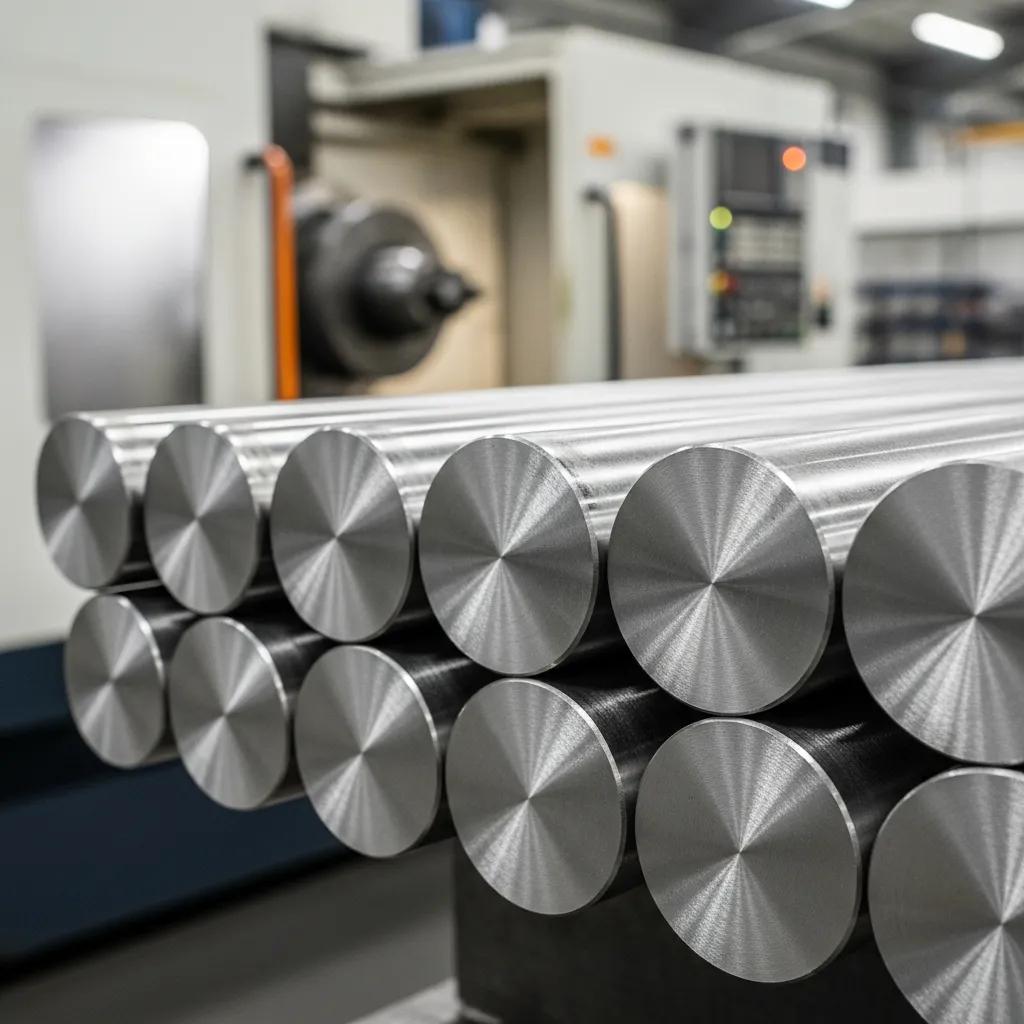
SAE 4140 Steel — A Practical Guide to Properties, Heat Treatment and High‑Stress Applications
SAE 4140 is a chromium–molybdenum low‑alloy steel commonly selected for demanding engineering parts because it blends hardenability, toughness and fatigue resistance in a heat‑treatable package. This guide walks through the alloy chemistry, key mechanical data and the heat‑treatment routes — annealing, normalizing, quenching, tempering and surface hardening — that manufacturers use to tune performance for shafts, gears and heavy components. You’ll find practical guidance on selecting process parameters and how 4140 compares with related grades such as 4130 and 4340. For buyers seeking material supply, Dhand Steels (Ludhiana, Punjab, India) stocks SAE 4140 as Alloy Steel Bright Bars and can supply finished bright‑bar forms ready for precision machining. The sections that follow cover composition and mechanical figures, stepwise heat‑treat effects, application notes by industry, supplier capabilities and a clear grade‑comparison to support specification and sourcing decisions.
Chemical Composition and Mechanical Properties of SAE 4140 Steel
SAE 4140 is a chromium–molybdenum alloy engineered with controlled amounts of carbon, chromium, molybdenum, manganese and silicon to provide hardenability and strength after heat treatment. Carbon primarily controls strength and hardness; chromium increases hardenability and wear resistance; molybdenum helps retain toughness and strength at elevated temperatures. Together these elements let manufacturers produce quenched‑and‑tempered microstructures where tempered martensite delivers the required hardness and fatigue performance. Below is a concise overview that links each element to its metallurgical role and typical content range.
The following table summarizes elemental ranges and primary roles in SAE 4140:
| Alloying Element | Primary Role | Typical Percentage Range |
|---|---|---|
| Carbon (C) | Strength, hardness, martensite formation | 0.38–0.43% |
| Chromium (Cr) | Hardenability, wear resistance | 0.80–1.10% |
| Molybdenum (Mo) | Strength at temperature, hardenability | 0.15–0.25% |
| Manganese (Mn) | Deoxidation, tensile strength | 0.75–1.00% |
| Silicon (Si) | Strength, deoxidation | 0.15–0.35% |
| Phosphorus (P) & Sulfur (S) | Impurities; affect machinability | ≤0.035% each |
This chemistry supports a wide mechanical range depending on thermal processing. The next section lays out typical mechanical property ranges and contrasts the annealed and quenched‑and‑tempered conditions to aid material selection.
Key Alloying Elements in Chromium–Molybdenum Steels
Cr–Mo steels such as SAE 4140 derive their performance from a careful balance of carbon and the chromium–molybdenum pair. Carbon (≈0.38–0.43%) sets the ceiling for hardenability and achievable hardness after quenching while still allowing reasonable weldability and fatigue life. Chromium (0.80–1.10%) extends hardenability and improves wear resistance; molybdenum (0.15–0.25%) enhances high‑temperature strength and refines martensitic stability. Manganese and silicon contribute deoxidation and modest strength increases, and low phosphorus and sulfur help preserve ductility and fatigue performance. Knowing these roles helps engineers pick heat‑treat and surface processes that match component demands.
Key Mechanical Properties of 4140 Steel
SAE 4140 covers a broad mechanical envelope: in the annealed state it offers good machinability with moderate tensile strength, while after quench‑and‑temper it achieves significantly higher tensile and yield strengths at controlled hardness levels. The typical ranges below are used for specification and design; actual values depend on testing methods and tempering targets.
The compact mechanical summary:
| Condition | Tensile Strength (MPa) | Yield Strength (MPa) | Hardness (HRC) | Elongation (%) |
|---|---|---|---|---|
| Annealed | 655–790 | 415–585 | 197–237 HB (approx 18–25 HRC) | 20–25 |
| Quenched & Tempered (typical) | 930–1,270 | 760–1,070 | 28–55 HRC (process dependent) | 10–18 |
| Normalized | 745–895 | 540–725 | 160–220 HB | 15–20 |
These ranges illustrate the trade‑offs designers manage: quench and temper raise strength and hardness while tempering restores toughness. Practical notes: machining is easiest in annealed or normalized conditions; welding is feasible with appropriate preheat and post‑weld treatment when carbon‑equivalent values are addressed; surface finish and compressive surface treatments boost fatigue life. The following section explains how each heat‑treat step produces those changes.
How Heat Treatment Enhances SAE 4140 Performance
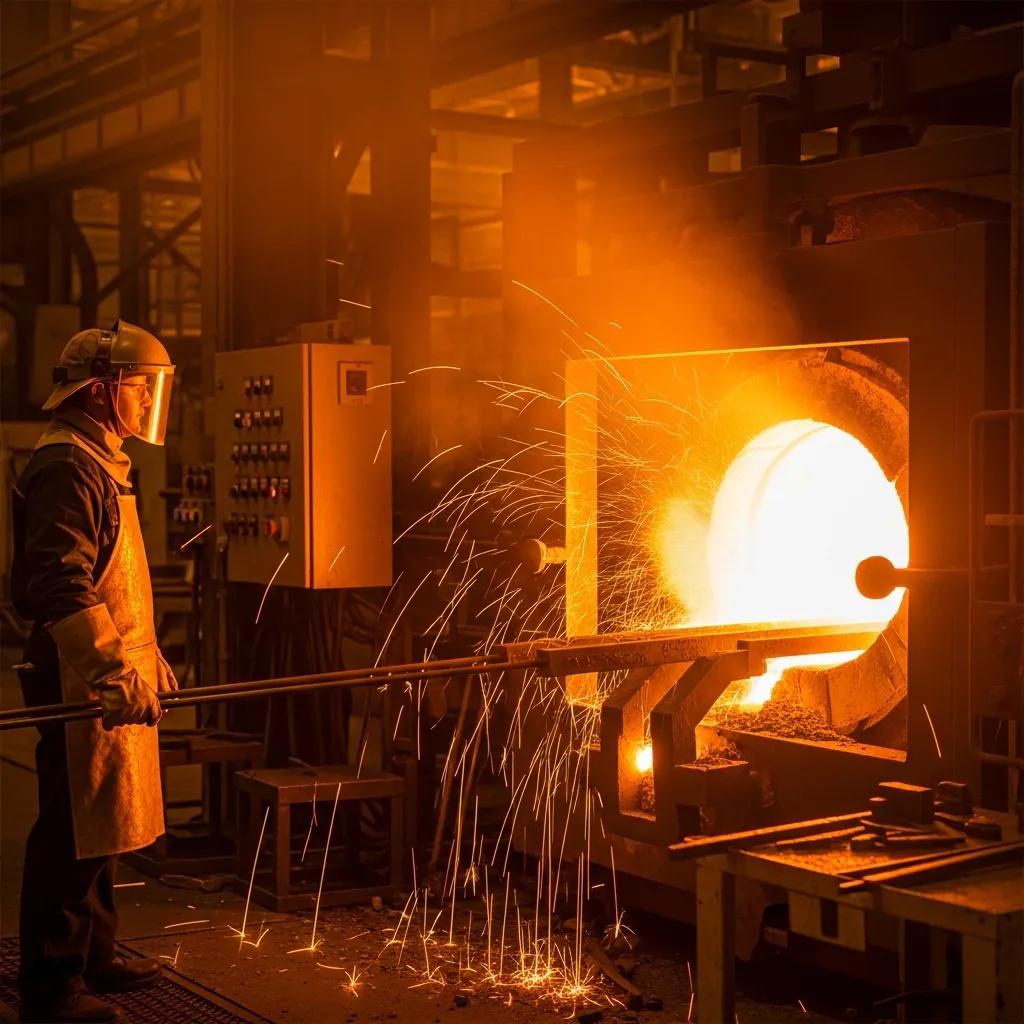
Heat treatment changes SAE 4140’s microstructure from ferrite/pearlite (annealed) to tempered martensite (quenched and tempered), allowing engineers to balance hardness, toughness and fatigue resistance for specific parts. Processes such as annealing, normalizing, quenching, tempering and surface nitriding/carburizing use defined temperatures and controlled cooling to change grain size, retained austenite and dislocation structures — all of which influence tensile strength, impact toughness and wear resistance. The table below links common processes to typical parameters and expected property outcomes so you can choose treatments for shafts, gears and drill components.
| Process | Parameters (Temp, Cooling) | Property Change |
|---|---|---|
| Annealing | 820–870°C, slow furnace cool | Lowers hardness, improves machinability and ductility |
| Normalizing | 870–920°C, air cool | Refines grain size, improves strength and toughness balance |
| Quenching | Austenitize 820–870°C, oil/polymer quench | Produces martensite for high hardness/higher strength |
| Tempering | 150–650°C (depending on target), air cool | Reduces brittleness, adjusts HRC and toughness |
| Nitriding/Carburizing | Surface-specific processes at 500–1050°C | Surface hardening with retained core toughness |
This mapping clarifies the trade‑offs: deeper quench increases hardenability but raises distortion risk; higher tempering lowers hardness while improving impact resistance, which suits impact‑loaded parts. The subsections below break down annealing/normalizing and quench/temper cycles with practical parameter ranges and processing advice.
Steps and Effects of Annealing and Normalizing 4140 Steel
Annealing and normalizing are preparatory steps used before extensive machining or final heat treatment. Annealing (≈820–870°C with slow furnace cooling) softens the material, relieves stress and improves machinability — typical hardness after anneal is around 197–237 HB with higher ductility for turning and milling. Normalizing (≈870–920°C, air cool) produces a more uniform, refined grain structure with increased tensile strength and toughness compared with the annealed state. Producers typically anneal when heavy machining is required and normalize when a stronger, more consistent starting microstructure is desired prior to quenching and tempering. Controlling soak times and cooling rates prevents undesirable grain growth and preserves reliable mechanical behavior.
How Quenching and Tempering Modify 4140 Properties
Quenching converts austenite to martensite by rapid cooling from the austenitizing range (typically 820–870°C). The quench medium — oil, polymer or air — controls cooling speed and hardenability; oil quenching is common for 4140 to achieve deep hardening while reducing cracking risk. Tempering (commonly 150–650°C) follows to reduce brittleness and tune hardness versus toughness. Low‑temperature tempering (150–250°C) keeps higher hardness and strength but lowers fracture toughness; higher tempering (400–600°C) reduces hardness to mid‑range HRC while restoring ductility and impact resistance. Avoiding temper‑embrittlement means choosing the correct tempering window and, if needed, applying post‑tempering stabilization. For part‑specific targets, select the tempering temperature to meet required HRC and tensile values and consider interrupted quench or sub‑critical stress relieve to control distortion.
High‑Stress Applications of SAE 4140 Across Industries
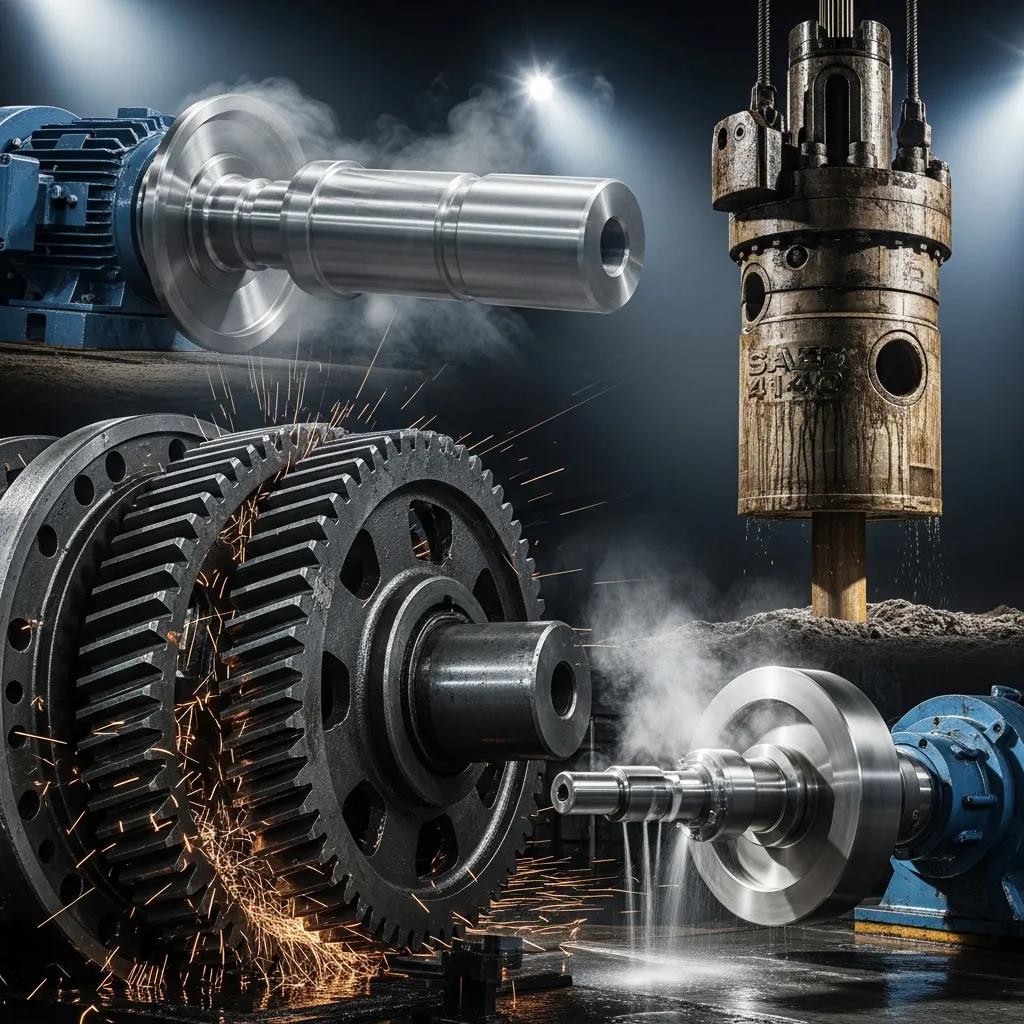
SAE 4140 is a go‑to material where fatigue strength, toughness and wear resistance must be balanced — especially for rotating shafts, gears, axles and heavy fasteners. Its ability to accept surface hardening while retaining a tough core makes it ideal for dynamic‑load components; choosing the right heat treatment aligns the part to its service conditions. Below are common components and the reasons 4140 is chosen for each.
- Gears and pinions: strong contact fatigue resistance and wear performance after carburizing or proper surface hardening.
- Shafts and axles: quenched‑and‑tempered cores provide torsional strength and long fatigue life.
- Crankshafts and connecting rods (light/medium duty): tempered to balance hardness and impact toughness.
- Drill collars and tool joints (oil & gas): high fatigue and impact resistance, commonly combined with nitriding for surface durability.
Designers typically aim for a tough core plus a hardened surface; selecting quench/temper schedules and surface treatments is the direct route to meeting those needs. The sections below show specific examples for automotive/aerospace and oil/gas/heavy machinery applications and highlight supplier considerations for bright bars and finished stock.
Use of 4140 Steel in Automotive and Aerospace Components
In automotive and aerospace applications, SAE 4140 is specified for parts that need a predictable balance of tensile strength and fracture toughness — items like axles, transmission shafts, secondary landing‑gear components and precision pins. Automotive practice commonly uses quench‑and‑temper to reach a target hardness that provides fatigue strength while preserving enough ductility to withstand impacts. Using bright bars with a fine surface finish and precise straightness reduces stress concentrators and improves fatigue life. Aerospace subcomponents that use 4140 are processed under strict heat‑treatment protocols and inspection regimes to ensure traceability and dimensional control. For precision parts, sourcing alloy steel bright bars reduces straightening and finishing needs; suppliers that can deliver high‑finished bright bars help shorten the production chain.
Roles of 4140 Steel in Oil, Gas and Heavy Machinery
The oil & gas and heavy machinery sectors demand steels with high fatigue life and impact resistance under cyclic and shock loads. SAE 4140 meets those needs for drill collars, tool joints, heavy shafts and pins when paired with suitable surface hardening. Nitriding or localized induction hardening are common choices to harden wear surfaces while keeping a tough, ductile core for shock absorption — important where bending and torsion act together. Maintaining dimensional stability during heat treatment is critical for large‑diameter bars and finished shafts, so process control and post‑treatment straightening are standard practice. Suppliers offering 4140 as bright bars can deliver stock that’s ready for high‑precision machining and consistent downstream results.
Why Choose Dhand Steels as Your Supplier of SAE 4140 Alloy Steel Bright Bars?
Dhand Steels is a privately owned manufacturer of bright bars and alloy bright bars based in Ludhiana, Punjab, India, and SAE 4140 is one of the grades we regularly supply. For procurement teams needing finished bright bar stock, we offer 4140 in Alloy Steel Bright Bar form with a focus on precision, consistent metallurgical quality and ready‑to‑machine finishes. Our capabilities include high‑finished, customizable shapes and thorough quality checks to support industrial customers who require reliable, precision stock.
Dhand Steels’ supplier advantages include the following verified value propositions:
- Precision manufacturing that delivers premium‑quality bright bars.
- Custom shapes and size ranges tailored for precision components.
- Multi‑stage quality checks to ensure dimensional and metallurgical consistency.
- An emphasis on cost‑effective production and measures to lower carbon emissions.
The subsections below outline our quality and customization offerings along with our sustainability and cost‑effectiveness commitments to help procurement decisions.
Quality and Customization Advantages from Dhand Steels
We use controlled manufacturing steps to produce straightened, aligned bright bars that reduce the need for heavy finishing and improve dimensional predictability for turned and ground parts. Custom options include special‑shaped bright bars and tailored size ranges so customers can order stock closer to final tolerances. Our inspection program verifies chemical composition, mechanical characteristics and surface finish at multiple stages, supporting components that will see demanding heat treatment and finishing. Buyers can request detailed product data on alloy grades and finishing choices when evaluating SAE 4140 bright bars for their supply chain.
How Dhand Steels Supports Sustainable and Cost‑Effective Steel Solutions
We prioritize process efficiency and material optimization to deliver cost‑effective steel products while working to reduce carbon emissions in our operations. Our sustainability emphasis is part of how we manage production and is offered alongside commitments to operational integrity and post‑sales support. Procurement teams focused on environmental performance can request our production or sustainability documentation and engage with us to align sourcing with corporate sustainability goals.
How SAE 4140 Compares to 4130 and 4340 Alloy Steels
Choosing between 4140, 4130 and 4340 depends on hardenability, toughness, weldability and cost trade‑offs. The matrix below highlights key attributes and common applications to help match the right grade to your component requirements.
| Grade | Key Attributes | Typical Applications / Advantages |
|---|---|---|
| SAE 4140 | Good hardenability, balanced toughness, strong after Q&T | Shafts, gears, axles, medium-duty crank components |
| SAE 4130 | Lower carbon, better weldability, moderate strength | Structural tubing, welded assemblies, aerospace tubing |
| SAE 4340 | Higher nickel and molybdenum, very high toughness/strength | High-stress gears, landing gear, heavy crankshafts where max strength needed |
This matrix shows 4140 as a widely available, cost‑efficient choice with good hardenability for bright‑bar production; 4130 is preferred where weldability and lower carbon are priorities; and 4340 suits cases where the highest toughness and strength justify higher alloying and cost. The following sections expand on direct comparisons and provide a short selection checklist.
Performance Differences Between 4140 and 4130
Compared with 4130, 4140 typically carries higher carbon and greater chromium/molybdenum, which yields better hardenability and higher achievable strength after quench and temper. That makes 4140 a better choice for parts needing higher hardness and wear resistance. By contrast, 4130’s lower carbon content improves weldability and simplifies joining in structural assemblies. Choose 4130 when welded construction and reduced post‑weld heat treatment are priorities; choose 4140 when core strength and fatigue resistance after heat treatment are critical. Use the checklist below to guide initial grade selection.
- If welding and post‑weld ductility are primary: Choose 4130.
- If higher quenched hardness and wear resistance are required: Choose 4140.
- If maximum toughness at very high strength is needed: Evaluate 4340.
This quick checklist helps align grade selection with manufacturing and service constraints before considering cost and availability.
Where 4140 Is a Better Choice Than 4340
While 4340 can achieve higher absolute strength and toughness thanks to added nickel and higher alloy content, 4140 often offers better cost‑effectiveness and availability for bright‑bar production and machining. 4140 is easier to source in finished bright‑bar form and its lower alloy cost can reduce part production expense while still delivering acceptable toughness for many uses. Choose 4340 when extreme toughness at very high tensile levels is mandatory and the extra material and processing cost are justified; choose 4140 where a balance of performance, manufacturability and cost is the priority, particularly for turned, ground and quenched‑and‑tempered components. This perspective helps procurement and design teams weigh trade‑offs against budget and performance targets.
Frequently Asked Questions
What is the typical heat treatment process for SAE 4140 steel?
The typical heat treatment sequence for SAE 4140 includes annealing, normalizing, quenching and tempering. The common austenitizing range is 820–870°C, followed by controlled cooling. Annealing softens the steel for machining, normalizing refines grain structure, quenching forms martensite to increase hardness, and tempering (150–650°C) adjusts hardness and restores toughness.
How does surface treatment affect SAE 4140 performance?
Surface treatments such as nitriding and carburizing significantly improve surface hardness while retaining a tough core. Nitriding introduces nitrogen to the surface to boost wear resistance and fatigue strength; carburizing enriches the surface with carbon to create a hard case that resists wear and extends fatigue life. These treatments are commonly used for components operating in demanding automotive, aerospace and industrial environments.
What advantages does SAE 4140 offer in high‑stress applications?
SAE 4140 combines good fatigue resistance, toughness and wear resistance. Its composition enables high strength after heat treatment, making it suitable for gears, shafts and axles that undergo dynamic loading. The alloy’s ability to accept various heat‑treat and surface‑hardening processes lets engineers tailor properties to specific service requirements, delivering reliable performance across many industries.
Can SAE 4140 be welded, and what precautions are needed?
Yes — SAE 4140 can be welded, but precautions are necessary to avoid cracking in the heat‑affected zone. Preheat is recommended to reduce thermal gradients, and post‑weld heat treatment may be needed to relieve residual stresses and restore ductility. Using compatible filler materials and correct welding procedures helps ensure a strong, reliable joint.
Which industries commonly use SAE 4140 and for what parts?
SAE 4140 is widely used in automotive, aerospace, oil & gas and heavy machinery. Common parts include gears, shafts, crankshafts and drill collars. Its mechanical properties make it a solid choice for components that require a balance of strength and fatigue resistance — for example, transmission parts and axles in automotive, and secondary landing‑gear or ground‑support components in aerospace.
How does the cost of SAE 4140 compare with 4130 and 4340?
SAE 4140 is generally more cost‑effective than 4340 due to lower alloy content, making it easier to source and process. 4340 provides higher strength and toughness but at higher material and processing cost. 4130 is typically less expensive than 4140 but offers lower hardenability and strength. As a result, 4140 often represents the best balance between performance and price for many industrial applications.
Conclusion
SAE 4140 is valued for its balanced combination of strength, toughness and wear resistance, making it a reliable choice for high‑stress applications across industries. A clear understanding of its chemistry and heat‑treatment options lets engineers and buyers select the right processing route for each part. As a supplier, Dhand Steels provides high‑quality, customizable 4140 bright bars that meet strict industry expectations — giving you consistent, ready‑to‑machine stock for precision components. Reach out to explore our 4140 offerings and see how the right material can improve your project outcomes.


Comments
0 Comment On Post