
EN15 Steel: Complete Guide to Properties, Uses and Heat Treatment Process
EN15 is a medium‑carbon, manganese‑stabilised engineering steel commonly supplied as bright bars for turned and machined parts. It offers a reliable mix of strength, hardenability and good machinability. This guide outlines what EN15 is, its chemical and mechanical profile, practical heat‑treatment schedules, typical applications, and how to match it to equivalent standards — giving engineers and buyers the facts they need to specify, source and process EN15 confidently. You’ll find exact chemistry ranges, how carbon and manganese affect hardenability, typical tensile/yield/hardness figures, step‑by‑step heat‑treatment options (anneal, normalize, quench & temper) with recommended temperature bands, plus quick reference tables and decision checklists for grade selection. Target keywords such as EN15 steel properties, EN15 chemical composition, EN15 heat treatment and EN15 bright bars are used so this serves as a practical technical reference for specification and procurement.
What is EN15 Steel? Overview and Key Characteristics
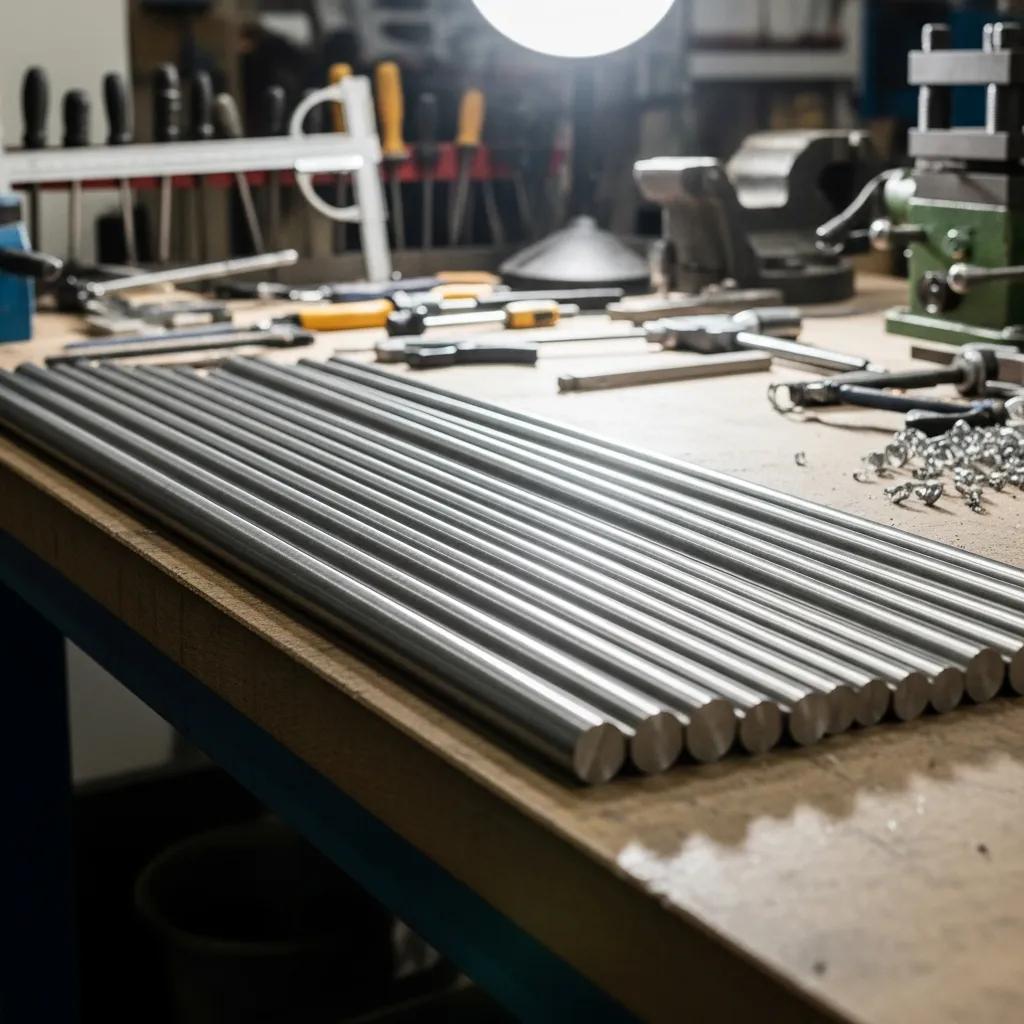
EN15 is a medium‑carbon, manganese‑bearing engineering steel most often supplied as bright bars for precision turned parts. With roughly 0.15–0.25% carbon and elevated manganese, EN15 balances tensile strength and hardenability while remaining easy to machine after annealing. Designers pick EN15 when a part needs more mechanical performance than low‑carbon steel but still requires efficient machining and consistent heat‑treatment response. Common uses include shafts, bolts, hydraulic fittings and other precision components where a bright‑bar finish improves straightness and surface quality.
What defines the chemical composition of EN15 steel?
EN15’s chemistry is driven by carbon and manganese with controlled levels of silicon, sulfur and phosphorus. Standards set narrow ranges and maximums so mills and heat‑treaters can deliver predictable behaviour. Carbon provides strength, manganese improves hardenability, silicon helps with deoxidation and strength, while sulfur and phosphorus are limited to protect toughness and fatigue life. Tight control of these elements is particularly important for bright bars, where surface finish and straightness are sensitive to inclusions and segregation.
Which mechanical properties make EN15 steel suitable for engineering applications?
EN15 combines moderate tensile and yield strengths with good machinability in the annealed state and the capacity to reach higher hardness after heat treatment. Annealed EN15 machines well and offers useful ductility; after quench and temper it can reach hardness levels suitable for wear‑resistant components. That flexibility — easy machining when soft, and achievable high hardness when treated — is why EN15 is widely used for turned shafts, bolts and small gears. The following section gives the precise composition ranges and explains each element’s role.
What is the Chemical Composition of EN15 Steel?
The chemical makeup of EN15 determines its hardenability, strength and machinability. The table below lists the principal elements, their typical ranges and the metallurgical effect to help designers and process engineers specify material for bright‑bar machining and heat treatment.
| Element | Typical % Range | Effect on Properties |
|---|---|---|
| Carbon (C) | 0.15–0.25 | Raises strength and achievable hardness; higher C increases hardenability but lowers weldability and ductility |
| Manganese (Mn) | 0.60–0.90 | Boosts hardenability and tensile strength and counteracts the effects of sulfur |
| Silicon (Si) | 0.10–0.35 | Acts as a deoxidizer and modest strengthener; excessive Si can reduce ductility |
| Sulfur (S) | ≤0.05 | Small amounts improve machinability; higher levels harm toughness and fatigue life |
| Phosphorus (P) | ≤0.05 | Can slightly increase strength but reduces toughness; kept low by standards |
This table shows how each element shapes EN15’s performance. Next we look at how carbon and manganese interact to control heat‑treatment response and mechanical behaviour.
How do carbon and manganese content influence EN15 steel properties?
Carbon is the principal determinant of strength and hardness: more carbon raises tensile strength and the hardness obtainable after quenching, but it reduces ductility and weldability. Manganese increases hardenability and tensile strength while reducing the negative effects of sulfur, allowing deeper hardened sections with less severe quenching. For designers the trade‑off is clear: increase carbon for wear resistance and strength, or keep it moderate if forming or welding is required and use manganese to tune hardenability. The correct balance ensures the selected heat‑treatment delivers the intended hardness, toughness and machinability.
What roles do silicon, sulfur, and phosphorus play in EN15 steel quality?
Silicon is mainly a deoxidizer and gives a small strength boost; controlled silicon improves steel cleanliness and predictability. Low sulfur aids free machining by forming sulfides, but excess sulfur reduces toughness and fatigue performance, so it’s limited. Phosphorus can raise strength slightly but hurts ductility and impact resistance at low temperatures, so standards cap its content. Bright‑bar producers manage these elements closely because surface finish, straightness and fatigue‑critical parts are sensitive to impurities.
What are the Mechanical Properties of EN15 Steel?
EN15’s mechanical data helps designers and heat‑treaters set safety factors, machining allowances and final treatment targets. The table below summarizes typical tensile, yield, elongation and Brinell hardness values in common conditions.
| Property | Typical Range / Value | Practical Implication |
|---|---|---|
| Tensile Strength (Rm) | ~480–650 MPa | Appropriate for medium‑duty structural and rotating parts; use the range to size components against operating loads |
| Yield Strength (Rp0.2) | ~275–420 MPa | Defines the elastic limit for design; important for stress calculations in shafts and fasteners |
| Elongation (A%) | ~12–18% (annealed) | Sufficient ductility for forming and machining when annealed; reduced after hardening |
| Brinell Hardness (HB) | ~120–250 HB (annealed to tempered states) | Indicates wear resistance; higher HB after quench & temper suits bearings and shafts |
These figures map material condition to application decisions. Below we give focused guidance on tensile and yield ranges and how they affect design margins.
What are the tensile strength and yield strength ranges of EN15 steel?
Tensile strength commonly lies between roughly 480 and 650 MPa depending on heat treatment, while yield strength typically ranges from about 275 to 420 MPa in usual conditions. Use the lower bounds for worst‑case elastic limits when sizing rotating parts or structural pins, and select tempering schedules that achieve the fatigue strength you need. Remember that machining in the annealed state and the final hardened condition place the component at different points on these spectra.
How do hardness, elongation, and impact resistance affect EN15 steel applications?
Hardness, ductility and impact resistance are a trade‑off: increasing hardness improves wear resistance but reduces elongation and impact toughness, raising the risk of brittle failure under shock. Tempering after quenching is the standard way to reach the desired balance — lower tempering temperatures keep more hardness, higher temperatures increase toughness and ductility. For parts subject to impact or cyclic loading, target a temper that prioritises toughness; for wear‑critical parts, accept a higher hardness with reduced ductility. Specify the service environment and load case up front so heat treatment and acceptance hardness match the application.
How is EN15 Steel Heat Treated? Step-by-Step Guide
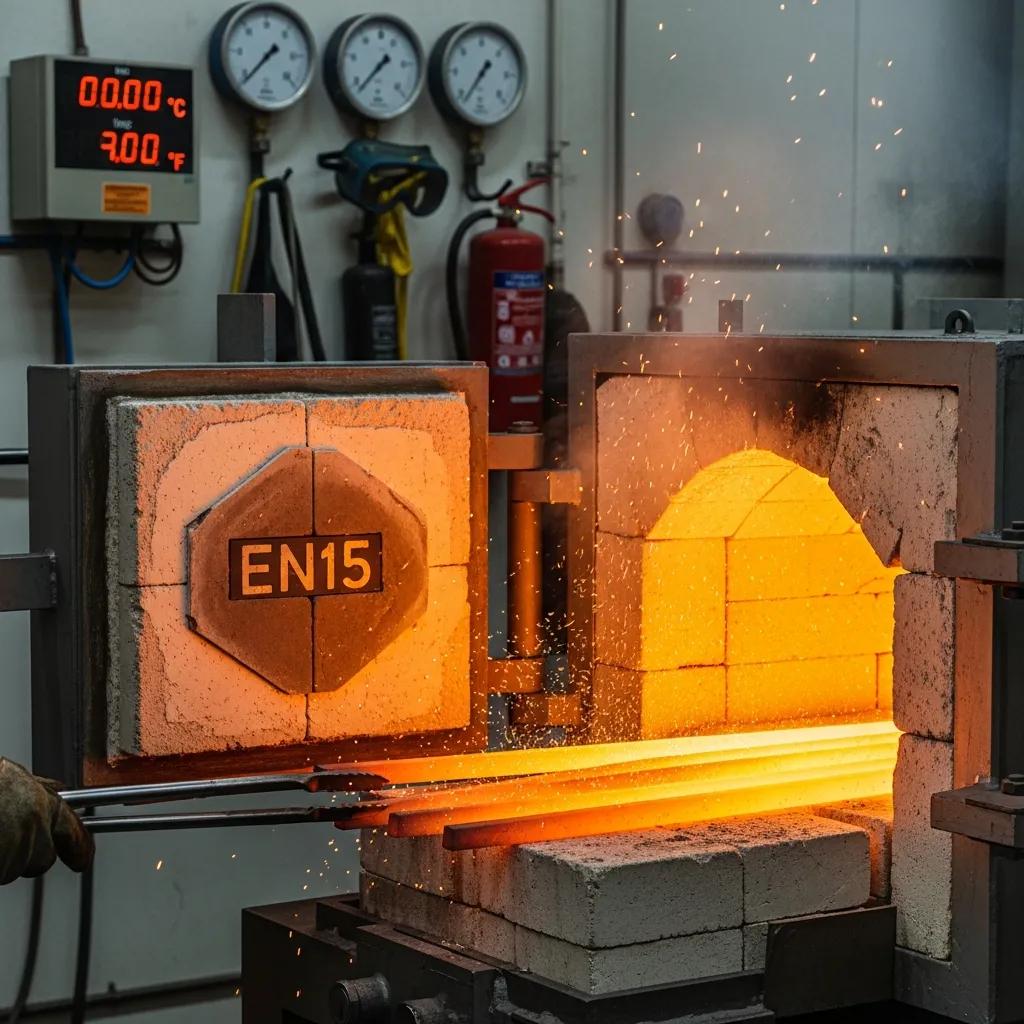
Heat treatment lets you convert EN15 from a soft, machinable state into hardened, tempered parts with controlled strength and toughness. Below is a concise how‑to covering core processes, recommended temperature bands, cooling media and expected outcomes. Maintain good process control to limit distortion, manage microstructure and ensure consistent results across production batches.
- Annealing: Heat to 680–720°C, soak to equalise temperature, then cool slowly in the furnace to soften and improve machinability. Annealing lowers hardness and relieves residual stress, making bright bars easier to machine to size.
- Normalizing: Heat to 840–900°C and air‑cool to refine grain structure and relieve internal stresses. Normalizing yields a tougher, more uniform microstructure than as‑rolled material.
- Hardening (Austenitise & Quench): Heat to 830–860°C, soak to austenitise, then quench in oil or a polymer quenchant to transform austenite to martensite for high hardness. Choose the quench medium to balance hardness depth against distortion risk.
- Tempering: Reheat to 150–600°C depending on the target hardness, soak and cool. Tempering reduces brittleness and tailors the hardness‑toughness balance to the application.
This sequence summarises typical cycles and their purpose. Below we expand on annealing and why it’s commonly specified before machining EN15.
What is the annealing process for EN15 steel and its benefits?
Annealing EN15 means heating into the lower austenite range (around 680–720°C), holding long enough for homogenisation, and cooling slowly in the furnace to room temperature. The result is lower hardness, a refined microstructure and relieved residual stresses from rolling — all of which improve machinability and surface finish on bright bars. Annealed EN15 is preferred for close‑tolerance turning or cold forming, since increased ductility and reduced spring‑back simplify finishing and reduce tool wear and the risk of cracking during secondary operations.
How do normalizing, hardening, quenching, and tempering modify EN15 steel properties?
Normalizing (840–900°C, air cool) refines grain size and produces a uniform ferrite‑pearlite structure that improves toughness and dimensional stability over as‑rolled stock. Hardening requires austenitising (≈830–860°C) followed by rapid quench in oil or polymer to form martensite and achieve high hardness; the quench medium and part section determine achievable depth of hardness and distortion risk. Tempering (150–600°C depending on desired final hardness) reduces brittleness and sets the final strength‑toughness balance: low tempering temperatures preserve hardness, higher temperatures increase ductility and impact resistance. Practical advice: use oil or polymer quench for moderate sections to control cracking, temper to the required HB for the application, and consider normalizing before final hardening to lower distortion risk.
Where to source EN15 bright bars ready for heat treatment and finishing: Dhand Steels manufactures, supplies and exports alloy steel bright bars and lists EN15 among the materials available in round, hex and HB wire forms. We focus on consistent quality, configurable shapes and a high‑finish product made with processes that reduce carbon intensity — practical benefits when specifying pre‑processed bright bars for further heat treatment and precision machining.
What are the Common Applications of EN15 Steel?
EN15 is widely used where a balance of strength, machinability and the option to reach higher hardness is required. Typical applications include shafts, bolts, small gears and hydraulic components, where a bright‑bar finish helps machining and holds surface tolerances. Its response to anneal and quench‑and‑temper cycles makes it popular across automotive, hydraulic and general engineering sectors.
EN15 is chosen for several specific component types:
- Shafts and axles: Provides the strength and hardness needed after heat treatment for rotating elements that demand dimensional accuracy.
- Bolts and fasteners: Bright‑bar finish and controlled chemistry deliver predictable thread performance and surface quality.
- Hydraulic fittings and spindles: Easy machining in the annealed state with the ability to harden locally suits precision hydraulic parts.
- Small gears and pins: Tempered martensite after quench & temper gives the wear resistance needed for low‑to‑medium duty gears.
How is EN15 steel used in automotive and heavy machinery components?
In automotive and heavy machinery EN15 is often supplied as turned shafts, pins, bushes and hydraulic parts where dimensional accuracy and dependable post‑heat‑treatment hardness are essential. Bright bars offer tighter straightness and surface finish than hot‑rolled stock, reducing secondary machining and improving concentricity. Typical production flows anneal for machining, harden for wear resistance and temper for the required toughness. Key manufacturing considerations include section thickness, quench severity and inspection for distortion or residual stresses.
What general engineering applications benefit from EN15 bright bars?
EN15 bright bars are common in general engineering, agricultural machinery and tooling where precision turned parts are required and a bright finish improves assembly fit and surface quality. Bright‑bar stock delivers better straightness, surface finish and closer diameter tolerances than hot‑rolled material, making it ideal for precision bearings, guide pins and fitted shafts. For small batches or customised shapes, EN15 bright bars reduce post‑machining grinding and achieve consistent geometric results, simplifying production when surface condition and dimensional stability are part of the specification.
Supplier note for buyers: For engineers needing ready‑to‑machine EN15 bright bars for automotive, hydraulic and heavy machinery parts, Dhand Steels supplies EN15 and EN15AM in round, hex and HB wire formats. We emphasise quality, configurable high‑finish products and production approaches that reduce carbon impact. Ask for mill test certificates and specify the required heat‑treatment condition and bright‑bar tolerances when requesting quotes or custom shapes.
What are the Equivalent Grades and Standards for EN15 Steel?
Cross‑referencing EN15 to other standards helps when substituting materials or sourcing internationally. The table below shows commonly referenced equivalents and notes practical differences to verify with your supplier. Use this as a starting point and always confirm composition and mechanicals with mill/test certificates.
| Standard System | Equivalent Grade | Notes on Differences / When to Prefer |
|---|---|---|
| British (BS/EN) | EN15 / EN15AM | Primary reference; always check chemical tolerances when matching |
| DIN (Germany) | Approx. C15 / C15E | Similar medium‑carbon category; verify Mn and impurity limits for hardenability |
| SAE / ASTM (US) | Approx. 1015 | Comparable carbon range; adjust for manganese and hardenability requirements |
While rough equivalents exist, exact chemistry and hardenability vary by standard and must be validated for critical parts. The checklist below helps decide when to select EN15 over nearby grades.
Which BS, DIN, and SAE grades correspond to EN15 steel?
One‑to‑one equivalents are approximate: EN15 broadly aligns with low‑ to medium‑carbon categories in other systems (for example C15‑style DIN or 1015 in SAE), but differences in manganese, silicon and impurity limits affect hardenability and toughness. When substituting, request the supplier’s chemical certificate and compare tensile strength and achievable hardness after heat treatment. For engineering interchange, choose the grade whose hardenability and temper response match your part’s section size and service demands rather than relying solely on name equivalence.
How to select EN15 steel over other similar grades like EN8 or EN16?
Choose between EN15, EN8 or EN16 by matching the material to required strength, machinability and post‑heat‑treatment targets. Use this checklist to guide the decision:
- Compare required tensile/yield: Pick the grade that meets design loads with appropriate safety margin.
- Assess hardenability needs: For deeper hardness in thicker sections select the grade with higher manganese/hardenability.
- Weigh machinability vs strength: If extensive machining is needed, prefer the grade that offers the best annealed machinability for your process.
- Consider cost and availability: Balance material cost against processing time and finish requirements when choosing a substitute.
For engineers ready to specify or procure EN15: Dhand Steels supplies EN15 bright bars in round, hex and HB wire forms and offers configurable high‑finish products. Our value propositions include consistent quality, engineering support for custom shapes and production methods that lower carbon impact. Always request mill test certificates and state required heat‑treatment and bright‑bar tolerances when requesting quotes.
Frequently Asked Questions
What are the advantages of using EN15 steel in manufacturing?
EN15 delivers a practical balance of strength, machinability and heat‑treatment versatility. Its medium‑carbon chemistry gives good wear resistance after heat treatment while the bright‑bar form improves surface finish and dimensional accuracy, cutting secondary machining. These qualities make EN15 a strong choice for precision parts in automotive, hydraulic and general engineering applications.
How does the heat treatment process affect the performance of EN15 steel?
Heat treatment changes EN15’s microstructure and mechanical properties to match application needs. Annealing softens the steel for easier machining; hardening produces martensite for higher hardness and strength; tempering then reduces brittleness and restores toughness. Controlled cycles let manufacturers tailor EN15 to required service conditions and ensure reliable in‑service performance.
What safety considerations should be taken when working with EN15 steel?
Follow standard safety practices: use appropriate PPE (gloves, goggles, face shields) to protect from sharp chips and edges during machining. For heat treatment, ensure equipment is correctly set up, allow for safe handling of hot parts and maintain good ventilation to avoid fumes. Fire safety and trained operators are essential during quenching and tempering operations.
Can EN15 steel be welded, and if so, what precautions should be taken?
EN15 can be welded, but its medium carbon content increases the risk of brittleness in the heat‑affected zone. Use preheat and, where necessary, post‑weld heat treatment to reduce cracking risk. Select compatible filler metals and follow appropriate welding procedures to maintain joint integrity.
What are the environmental considerations when sourcing EN15 steel?
Consider supplier practices and carbon footprint when sourcing EN15. Choosing mills and distributors that prioritise lower emissions, efficient processes and traceability helps reduce environmental impact. Also account for material recyclability and the energy used across the product lifecycle when making procurement decisions.
How does the cost of EN15 steel compare to other similar grades?
EN15 is typically competitive with grades like EN8 and EN16, but price depends on market conditions, supplier terms and any processing required. When evaluating cost, account for total lifecycle value — material price, machining time, heat treatment and final performance — and compare quotes from multiple suppliers to find best value.
Conclusion
EN15 is a versatile, medium‑carbon engineering steel that combines machinability in the annealed state with the ability to reach useful hardness after heat treatment — ideal for precision components across automotive, hydraulic and general engineering. Understanding its composition, mechanical ranges and heat‑treatment options helps engineers specify the right process and acceptance criteria. For high‑finish EN15 bright bars, Dhand Steels offers configurable shapes and consistent quality; contact us with your specifications, required heat‑treatment condition and mill test certificate needs to get a tailored quote for your project.


Comments
0 Comment On Post