
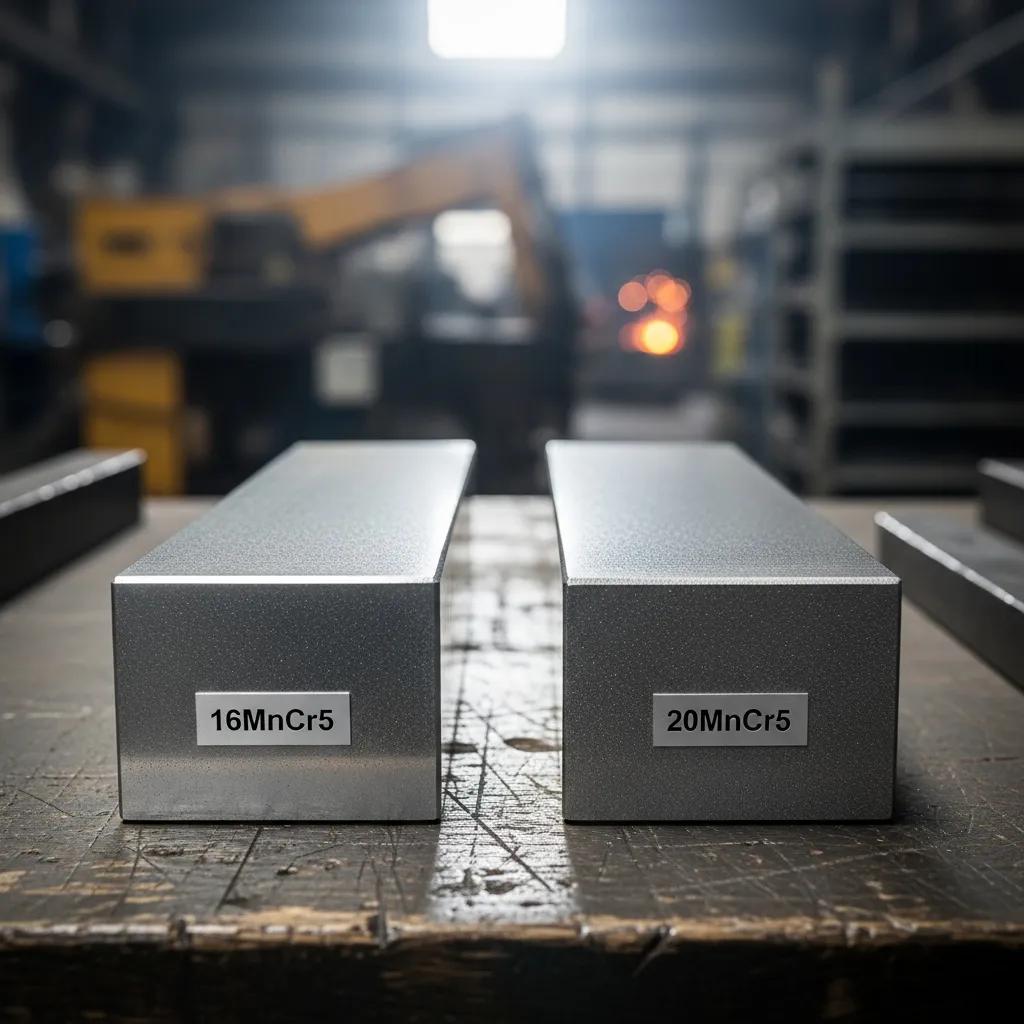
16MnCr5 vs 20MnCr5 — Practical Comparison & Application Guide for Case‑Hardening Steels
At Dhand Steels, we work with both 16MnCr5 and 20MnCr5 regularly. Both grades are engineered for carburizing, quenching and tempering to produce a hard, wear‑resistant surface over a tough, ductile core. Design and procurement teams choose between them based on small—but important—differences in carbon and manganese that affect hardenability, core strength and fatigue life. This guide lays out composition ranges, connects composition to mechanical behavior, and summarizes heat‑treatment windows that determine achievable case depth and surface hardness. You’ll find side‑by‑side comparison tables for chemistry, mechanical properties and heat‑treatment parameters, a practical selection checklist, and application guidance for automotive, industrial and heavy‑duty parts. Toward the end we note how a bright‑bar supplier can support procurement and customization. Read on to see when extra carbon and manganese are worth the trade‑offs — and when a more economical choice meets your needs.
Key metallurgical differences between 16MnCr5 and 20MnCr5 steels
Both are low‑alloy, case‑hardening steels, but the main distinction lies in nominal carbon and manganese levels. 20MnCr5 typically has slightly higher carbon and manganese than 16MnCr5, which increases hardenability and allows deeper effective case depths for the same carburizing cycle. Chromium is similar in both grades and supports a stable carburized surface and improved hardenability, while silicon, sulfur and phosphorus are controlled for cleanliness and cold‑working behavior. Knowing these elemental differences helps engineers predict heat‑treatment results and match material choice to wear, fatigue and impact requirements.
Before we dive into numeric details, the table below summarizes typical composition ranges so you can compare the key elements at a glance.
Carbon and manganese are the decisive elements for selection; the following subsection explains how each influences processing and performance.
| Element | 16MnCr5 (wt%) | 20MnCr5 (wt%) |
|---|---|---|
| Carbon (C) | 0.14–0.19 | 0.17–0.24 |
| Manganese (Mn) | 0.80–1.10 | 0.80–1.30 |
| Chromium (Cr) | 0.30–0.50 | 0.30–0.50 |
| Silicon (Si) | 0.10–0.40 | 0.10–0.40 |
| Sulfur (S) | ≤0.035 | ≤0.035 |
| Phosphorus (P) | ≤0.035 | ≤0.035 |
The table highlights 20MnCr5’s modestly higher carbon and manganese ranges, which translate to greater hardenability and slightly higher core strength after quench and temper. The next subsection explains these numeric differences and their practical effects.
How carbon, manganese and chromium differ between the two grades
Carbon is the single most influential variable for core strength and final hardness: 16MnCr5 typically contains about 0.14–0.19 wt% C, while 20MnCr5 ranges from 0.17–0.24 wt% C. Higher carbon increases the martensite fraction after quench, raising core tensile strength but potentially reducing toughness unless tempered properly. Manganese stabilizes austenite and boosts hardenability; the higher manganese in some 20MnCr5 chemistries promotes deeper hardening under identical quench conditions. Chromium aids grain refinement and supports the carburized case response. Although the differences are small on paper, they produce meaningful shifts in achievable mechanical properties and in the practical heat‑treatment window for case hardening.
Small compositional changes are therefore magnified by heat treatment; the next subsection translates those changes into expected property differences.
How these chemistry differences affect steel properties
Higher carbon and manganese in 20MnCr5 increase hardenability and potential core strength after quenching—advantages for components subject to bending fatigue and shock. By contrast, 16MnCr5 typically offers marginally better baseline toughness and easier machining before hardening, which can reduce manufacturing cost for lighter‑duty parts. Chromium in both grades improves tempering resistance of the case and aids wear performance after carburizing. Trade‑offs include slightly reduced weldability and more careful tempering for the higher‑carbon grade; with the proper temper schedule you can restore ductility while keeping surface hardness. These cause‑and‑effect relationships help engineers choose the grade that matches required case depth, fatigue life and production constraints.
Comparing mechanical properties of 16MnCr5 and 20MnCr5
After carburizing, surface performance is similar for both grades, but core properties diverge because of the carbon and manganese differences—20MnCr5 typically delivers higher core tensile and yield strengths for the same heat treatment. The case‑to‑core gradient is central to part performance: a hard case resists wear while a ductile core absorbs shocks and prevents brittle failure. Evaluate both core tensile/yield values and achievable surface hardness when specifying materials. The table below shows representative mechanical ranges and typical outcomes after standard case‑hardening cycles.
| Property | 16MnCr5 Typical Range (as-processed) | 20MnCr5 Typical Range (as-processed) |
|---|---|---|
| Tensile strength (MPa) | 600–780 | 650–850 |
| Yield strength (MPa) | 350–520 | 380–560 |
| Core hardness (HBW) | 170–220 | 180–240 |
| Surface hardness after carburizing (HRC) | 55–62 | 56–63 |
| Toughness (qualitative) | Good | Slightly lower if not tempered properly |
| Fatigue resistance (qualitative) | Adequate for light gears | Improved for high-load gears |
Overall, 20MnCr5 has an edge in strength and hardenability, which can translate to longer life under heavy cyclic loading. The following subsections unpack strength/hardness numbers and qualitative differences in toughness and wear behavior.
Differences in tensile strength, yield and hardness
In practice, 20MnCr5 usually shows modestly higher tensile and yield strengths—on the order of tens of MPa—after equivalent carburizing and tempering, because higher carbon and manganese promote a larger martensitic fraction in the core. Surface hardness after carburizing can be comparable when the case chemistry and cycle are identical, but 20MnCr5 can maintain hardness deeper below the surface. That means, for the same part geometry and heat treatment, a 20MnCr5 component will often withstand higher static and dynamic loads before yielding. Consistent heat‑treatment control—quench severity and temper schedule—remains essential to reach the intended balance of strength and ductility.
These numeric differences help direct material choice: 20MnCr5 for strength‑critical parts, 16MnCr5 when slightly better pre‑hardening machinability and toughness are priorities.
Toughness, wear resistance and fatigue — what changes between grades
Toughness generally falls as carbon increases, so 16MnCr5 offers a small toughness advantage in the core when processed the same way. Careful tempering, however, can restore ductility in 20MnCr5 to acceptable levels. Wear resistance depends mainly on achievable case hardness and case depth rather than bulk composition: both grades can reach similar surface hardnesses, but 20MnCr5’s higher hardenability helps preserve hardness at greater depths, improving wear life in deeper‑contact applications. For fatigue strength, a deeper, well‑tempered case combined with a tough core usually performs best—conditions where 20MnCr5 can outperform 16MnCr5 in heavy‑duty gears and shafts. For precise fatigue predictions, engineers should consult fracture‑mechanics data and S‑N curves in their validation work.
Key heat‑treatment processes for 16MnCr5 and 20MnCr5
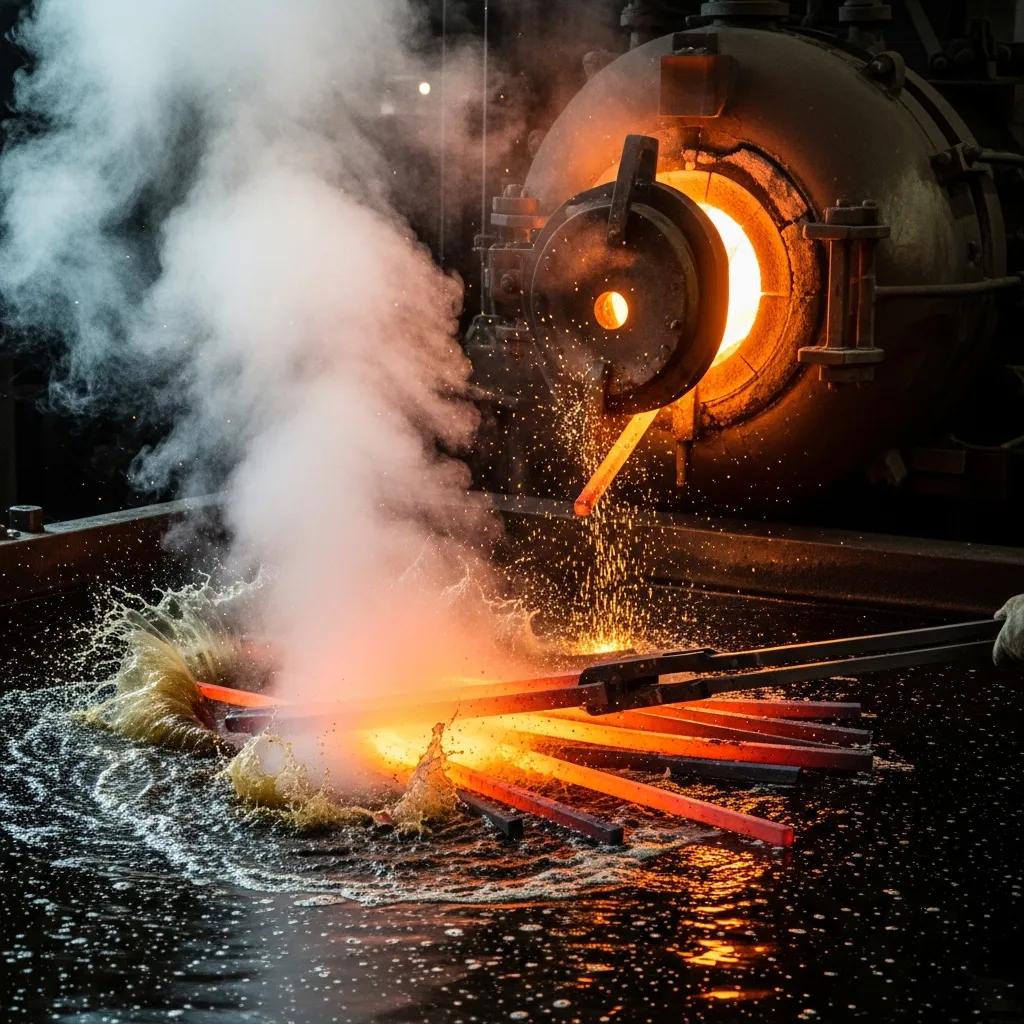
Carburizing followed by quenching and tempering is the standard route to a hard case and a ductile core for both grades. Parameters are adjusted for composition and component geometry to hit the required case depth and core toughness. Carburizing raises surface carbon, quenching transforms austenite to martensite in the case, and tempering reduces brittleness while stabilizing hardness. Because 20MnCr5 is marginally more hardenable, you can either reduce quench severity to limit distortion or reach deeper effective case depths with the same cycle. The table below summarizes typical process steps, common parameter ranges and expected results engineers use when planning heat‑treatment cycles.
| Process Step | Typical Parameter | Typical Result |
|---|---|---|
| Carburizing temperature | 880–930 °C | Surface carbon enrichment enabling HRC >55 after quench |
| Carburizing duration | 1–10 hours (dependent on depth) | Case depth 0.5–2.5 mm typical; longer for deeper cases |
| Quenching medium | Oil or polymer quenchant | Rapid cooling to form martensitic case |
| Tempering range | 150–220 °C (for high case hardness) | Relieves stresses and adjusts core toughness |
| Achievable case depth | 0.5–3.0 mm (process dependent) | Deeper effective case in 20MnCr5 due to hardenability |
These parameters are starting points: component geometry, section size and furnace control dictate the final cycle. The next subsections detail parameter differences and achievable case metrics.
Carburizing, quenching and tempering — where the grades differ
Both grades commonly carburize between 880 and 930 °C, and cycle times are chosen to hit the target case depth—short for thin cases, longer for deep ones. Because 20MnCr5 often has slightly higher carbon/manganese, it responds with a deeper hardened profile for the same cycle, so quench severity can sometimes be eased to reduce distortion while still meeting hardness goals. Tempering windows overlap, but if the core hardness is very high you may need a higher temper temperature to restore toughness. Tight process control—monitoring case carbon, microstructure and residual stress—is critical to achieve the right balance between wear resistance and core ductility.
Routine quality controls such as microhardness traverses and nondestructive inspection validate that your heat‑treatment produced the intended case and core properties.
Typical case depths and surface hardness you can expect
Effective case depths commonly range from about 0.5 mm for light wear surfaces up to 2.5–3.0 mm for heavily loaded gears and shafts. 20MnCr5 is often chosen when required depths exceed roughly 1.5–2.0 mm without using very aggressive quench media. Surface hardness after proper carburizing, quench and temper typically reaches HRC 55–62 for both grades; reaching the top of that range depends on carbon potential during carburizing and quench effectiveness. Core hardness targets are usually kept lower (for example, 180–230 HBW) to preserve ductility and fatigue resistance. Always specify required case depth and surface hardness on drawings so heat‑treatment vendors can apply the correct cycle.
Measuring case depth with microhardness profiles and maintaining a controlled furnace atmosphere are standard practices to confirm targets.
Applications best suited to 16MnCr5 and 20MnCr5
Both grades are common for parts that need a wear‑resistant case and a tough core. Choice depends on load magnitude, required case depth and fatigue demands. 16MnCr5 is a strong candidate for many light‑to‑medium duty automotive and mechanical parts where manufacturability and cost matter; 20MnCr5 is often specified for higher‑load gearsets and heavy machinery where deeper cases and greater core strength improve life. Below are typical application categories and the reasoning behind material selection.
The following list summarizes common application categories and selection rationale.
- Automotive driveline and light gears: 16MnCr5 for moderate loads and cost efficiency.
- Heavy transmission gears and axle shafts: 20MnCr5 when deeper case and higher core strength are required.
- Industrial machinery components: choose by fatigue loading; 20MnCr5 favours high cyclic demands.
These groupings guide an initial choice; final selection should factor in geometry, heat‑treatment feasibility and lifecycle cost. The next subsections give component‑level examples.
Automotive and light‑duty components that use 16MnCr5
16MnCr5 is commonly specified for clutch parts, pinion gears, small transmission gears and cam followers where moderate case depth with a resilient core gives long life without the premium of higher hardenability. Its slightly lower carbon content makes it easier to machine and finish into precision bright bars and shafts, lowering initial manufacturing cost and enabling tight tolerances before carburizing. For thin sections or parts that must minimize distortion during heat treatment, 16MnCr5’s processing advantages are valuable. With a controlled carburizing cycle, 16MnCr5 provides excellent surface wear life for many light-duty automotive applications.
Since machining and finishing are often done before carburizing, the grade’s good cold‑working and straightening behavior helps producers manage cost and quality.
Heavy‑duty gears and machinery where 20MnCr5 is preferred
20MnCr5 is a frequent choice for heavy transmission gears, large pinions, axle shafts and industrial gearboxes where deeper case depth, improved hardenability and higher core strength extend fatigue life under heavy cyclic loads. The higher carbon and manganese content supports a stronger load‑bearing core after tempering, helping parts resist pitting and bending fatigue over long intervals. For gear teeth under significant contact stress, 20MnCr5 can deliver measurable life improvements that justify a modest material cost increase. With careful process control—choosing the right quench medium and temper schedule—you can manage distortion even on larger parts.
Designers commonly pair 20MnCr5 with controlled carburizing and precision grinding to maximize service life in demanding gear applications.
How to choose between 16MnCr5 and 20MnCr5 for your project
Selection balances engineering needs, manufacturing constraints and lifecycle cost. Most decisions come down to required case depth, load type, fatigue expectations and cost tolerance. Use a structured checklist to make the choice repeatable across projects. Below is an actionable checklist you can use during design reviews and procurement calls.
Use this checklist to guide material choice in a design review or procurement specification:
- Assess required case depth and surface hardness: deeper cases favor 20MnCr5.
- Evaluate load magnitude and fatigue cycles: high cyclic loads favor 20MnCr5.
- Consider manufacturability and machining needs: 16MnCr5 often offers easier pre‑heat‑treatment machining.
- Factor cost and lead time: compare processing complexity and total lifecycle cost.
- Confirm heat‑treatment capability: ensure your supplier controls carburizing atmosphere and quench severity.
This checklist focuses the decision; the subsection below explains each factor in more detail and links selection to procurement considerations.
Factors that influence grade selection: load, impact and cost
Key considerations include mechanical loading (static versus cyclic), expected impact events, required case depth to resist surface fatigue, desired core ductility for shock absorption, machining and finishing needs, and the economics of material plus processing. Load and fatigue often dominate: gears under high bending stress or repeated contact cycles usually justify 20MnCr5’s higher hardenability. Manufacturing concerns—such as tolerances achievable before carburizing and post‑hardening straightness—can favour 16MnCr5 when distortion control is critical. Procurement constraints, like availability of bright bars in specific diameters and lead times for custom shapes, also affect selection and should be discussed with suppliers early.
A pragmatic approach combines engineering requirements with vendor capabilities to avoid late changes that add cost and delay.
(Integration note) When you’re ready to procure finished bright bars, suppliers can deliver both 16MnCr5 and 20MnCr5 bright bars, provide datasheets and quote lead times for custom lengths and profiles. Early discussion of expected case depth and surface hardness with your bright‑bar supplier helps align specifications and reduces rework.
Cost‑benefit and performance trade‑offs
In short: 16MnCr5 typically offers lower material cost and easier machining, saving initial processing for light‑duty parts. 20MnCr5 can extend service life and reduce downtime in heavy‑duty applications where deeper cases and higher core strength lower failure rates. Total cost of ownership should include material price, heat‑treatment complexity, finishing operations (grinding, shot‑peening) and service life. In many heavy‑load scenarios the slightly higher upfront cost of 20MnCr5 is offset by longer maintenance intervals. Decision‑makers should run a lifecycle cost estimate—comparing replacement cycles and downtime risk—to justify a higher‑hardening grade when appropriate.
Often a modest material premium is economical when it prevents frequent replacements under heavy stress.
Why choose Dhand Steels for 16MnCr5 and 20MnCr5 bright bars?
Dhand Steels manufactures, supplies and exports bright bars and alloy bright bars from Ludhiana, Punjab. We supply 16MnCr5 and 20MnCr5 bright bars for industrial customers, offering high‑finished, customizable shapes and a client‑focused manufacturing approach. Our capabilities include meeting diameter, length and straightness specifications that are important before carburizing. Our way of working — integrity, practical engineering and responsive service — matches the needs of design and procurement teams who require consistent quality for case‑hardening applications. Below are the core supplier advantages we deliver.
Dhand Steels provides supplier capabilities that support engineers and purchasing teams:
- Stringent quality checks and precisely chosen raw materials: ensuring bars meet chemical and dimensional tolerances required for reliable case hardening.
- High‑finished products with customizable shapes: enabling pre‑machining and finish work that reduce downstream processing.
- Flexible, client‑focused service: tailoring offerings to project‑specific requirements.
These capabilities make Dhand Steels a practical partner when your specification requires consistent chemistry, tight dimensional accuracy and procurement support.
Quality assurance and customization options at Dhand Steels
We apply strict quality checks and can supply high‑finished bright bars in customer‑specified shapes to support close‑tolerance manufacturing and consistent heat‑treatment outcomes. QA measures include careful selection of raw materials and inspection routines aligned with engineering tolerances for chemistry and dimensions before carburizing. Custom options — specific diameters, lengths and finish levels — let us deliver bars that cut down pre‑heat‑treatment machining and reduce distortion risk. These QA and customization practices reduce starting‑material variability and support component reliability.
Working with a supplier that enforces these checks lowers process variability and smooths the path from raw material to finished, case‑hardened component.
How Dhand Steels supports industrial applications
We serve manufacturing, agriculture, automotive, railways, construction and heavy engineering — sectors that commonly require case‑hardened bright bars for gears, shafts and other wear‑critical parts. As an exporter and supplier, we help procurement teams source 16MnCr5 and 20MnCr5 bright bars for domestic and international projects, and our post‑sales support sustains long‑term industrial relationships. Post‑sales service and adaptability help keep serial production on spec and maintain uptime. For projects needing datasheets, quotes or tailored bar profiles, early engagement with us shortens lead time and sets clear quality expectations.
Frequently Asked Questions
What are the main applications for 16MnCr5 and 20MnCr5 steels?
16MnCr5 is commonly used in automotive parts such as clutch components, small transmission gears and cam followers, where moderate loads and cost efficiency matter. 20MnCr5 suits heavy‑duty applications like transmission gears, axle shafts and industrial gearboxes, where deeper cases and higher core strength support durability under high cyclic loads. Match the grade to the application’s load and life expectations.
How does the cost of 16MnCr5 compare to 20MnCr5?
Generally, 16MnCr5 costs less because of its lower carbon and manganese, which eases machining and processing. That makes it attractive for light‑duty parts. 20MnCr5 is typically more expensive up front but can lower total cost of ownership in heavy‑duty use by extending service intervals and reducing downtime. A lifecycle cost analysis will show which option is most economical for your case.
What should be considered when heat treating these steels?
Key factors are carburizing temperature and duration, quench medium and tempering range. Both grades usually carburize between 880–930 °C, but 20MnCr5 may achieve deeper cases with less severe quenching due to higher hardenability. Tight control of these parameters is essential to balance surface hardness and core toughness for the intended application.
What are the typical mechanical properties of 16MnCr5 and 20MnCr5?
Typical ranges: 16MnCr5 tensile strength 600–780 MPa and yield 350–520 MPa; 20MnCr5 tensile 650–850 MPa and yield 380–560 MPa. 20MnCr5 typically gives higher core hardness and improved fatigue resistance, making it a better choice where strength and durability are critical. Use these ranges to inform design margins and heat‑treatment targets.
How do toughness and wear resistance compare between these steels?
16MnCr5 generally offers slightly better core toughness because of lower carbon, while 20MnCr5 provides superior wear resistance for deeper‑contact applications thanks to better hardenability. Both grades can reach similar surface hardness, but 20MnCr5 maintains hardness at greater depths. Consider the required case depth and the part’s wear environment when selecting.
What role does the supplier play in selecting 16MnCr5 and 20MnCr5?
The supplier ensures quality, availability and alignment with processing needs. Reliable suppliers provide QA documentation, customization of bright bars and support for heat‑treatment discussions. Early engagement with your supplier helps match material specification to production capability and reduces the risk of late changes.
Conclusion
Choosing between 16MnCr5 and 20MnCr5 matters for case‑hardening performance. Each grade brings trade‑offs: 16MnCr5 for cost‑sensitive, light‑duty parts and easier pre‑hardening machining; 20MnCr5 for deeper cases, higher core strength and better performance under heavy cyclic loads. Understanding metallurgical and mechanical differences lets you make a confident choice that improves component life and lowers total cost. For tailored bright bars, precise chemistry and reliable delivery, contact our team — we’ll help specify the right material and processing route for your application.



Comments
0 Comment On Post